Term:
- get my head around
get my head around (idiom/verb phrase) /ɡet maɪ hed əˈraʊnd/
Similar to: understand; comprehend; grasp; fathom; make sense of
Definition: to succeed in understanding something that is complicated, strange, or difficult to accept.
Translation: aptvert, izprast, tikt skaidrībā, sagremot (pārnestā nozīmē)
Examples:
"I’m trying to get my head around these new tax laws, but they are so confusing."
"It took me a while to get my head around the fact that we were moving to another country."
"Can you explain the math problem again? I just can't get my head around it." - handle
handle (verb) /ˈhæn.dəl/
Similar to: manage; deal with; control; cope with; manipulate
Definition: to touch or move something with your hands; or to be in charge of a situation or problem.
Translation: rīkoties, tikt galā, apstrādāt, aiztikt
Examples: "Please wash your hands before you handle the food." "She is very experienced and knows exactly how to handle difficult customers." "I don't think I can handle any more stress this week."
***
handle (noun) /ˈhæn.dəl/
Similar to: grip; knob; shaft; lever; hilt
Definition: the part of an object designed to be held or touched by the hand in order to open, lift, or move it.
Translation: rokturis, kāts, osa
Examples: "The brass handle on the front door was polished and shiny." "Be careful, the handle of the pan is very hot." "The suitcase was heavy, and the leather handle felt like it might break." - sap
sap (verb) /sæp/
Similar to: drain; erode; weaken; exhaust; undermine
Definition: to gradually weaken someone’s strength, confidence, or energy over a period of time.
Translation: izsmelt, novājināt, atņemt spēkus
Examples: "Working long hours in the sun will quickly sap your energy." "The constant criticism began to sap his self-confidence." "Repeated setbacks can sap a team's motivation to finish the project."
- weaken
weaken (verb) /ˈwiː.kən/
Similar to: undermine; enfeeble; diminish; impair; sap
Definition: to make someone or something less strong, powerful, or effective; or to become less strong yourself.
Translation: pavājināt, novājināt, kļūt vājākam
Examples: "The constant rain started to weaken the old wooden bridge." "Taking antibiotics for a long time can sometimes weaken your immune system." "The scandal served to weaken the public's trust in the government."
weakened (adj) /ˈwiː.kənd/
Similar to: impaired; fragile; diminished; enfeebled; debilitated
Definition: made less strong, healthy, or powerful than before.
Translation: novājināts, pavājināts
Examples: "The patient had a weakened immune system after the long illness." "The economy was severely weakened by the sudden fall in exports." "The old house had a weakened structure after the heavy floods.
- calm
calm (adj) /kɑːm/
Similar to: peaceful; serene; tranquil; quiet; relaxed
Definition: not excited, nervous, or upset; also used to describe weather or water that is still and without strong wind or waves.
Translation: mierīgs, rāms, klusējošs
***
calm (verb) /kɑːm/
Similar to: soothe; quieten; relax; pacify; settle
Definition: to make someone or something become quiet or relaxed, especially after they have been excited or upset.
Translation: nomierināt, nomierināties
***
calm (noun) /kɑːm/
Similar to: peace; stillness; tranquility; composure; serenity
Definition: a state of being quiet and peaceful; a period of time without trouble, excitement, or wind.
Translation: miers, klusums, bezvējš
***
Examples:
adj - "It is important to stay calm during an emergency." "The sea was very calm this morning, with almost no waves." "He has a very calm voice that makes people feel at ease."
verb - "The mother tried to calm her crying baby." "Taking deep breaths can help to calm your nerves before a presentation." "The rain eventually stopped, and the wind began to calm down."
noun - "There was a strange calm in the air just before the storm started." "I enjoy the calm of the library when I need to study." "She handled the crisis with great calm and professionalism." - concerned
concerned (adj) /kənˈsɜːnd/
Similar to: worried; anxious; troubled; interested; involved
Definition: feeling worried or nervous about something; or being involved in or affected by a particular situation.
Translation: noraizējies, bažīgs, iesaistīts, ieinteresēts
Examples: "Many citizens are deeply concerned about the rising cost of living." "The concerned parents met with the teacher to discuss the new school rules." "Everyone concerned in the project must attend the briefing tomorrow morning."
- concern
concern (noun) /kənˈsɜːn/
Similar to: worry; anxiety; interest; matter; consideration
Definition: a feeling of worry or care about a situation; or something that is important to you.
Translation: bažas, rūpes, interese, jautājums
(verb) /kənˈsɜːn/
Similar to: affect; involve; touch; worry; bother
Definition: to relate to or be about something; or to make someone feel worried. Translation: attiekties, uztraukt, interesēt
Examples:
noun - "The doctor expressed concern about the patient's high blood pressure." "The safety of the children is our primary concern." "It is no concern of mine what they decide to do with their money."
verb - "This new law will concern everyone who owns a small business." "The report concerns the latest developments in renewable energy." "It concerns me that he hasn't called to say he arrived safely."
- chair
chair
(verb) /tʃer/
Similar to: preside; lead; moderate; oversee; direct
Definition: to be the person in charge of a meeting, a committee, or a formal discussion.
Translation: vadīt (sēdi), prezidēt, būt priekšsēdētājam
Examples:
"The most senior member of the board will chair the meeting today."
"She was asked to chair the committee responsible for the new budget."
"Who is going to chair the debate between the two candidates?"
(noun) /tʃer/
Similar to: seat; armchair; bench; stool; chairperson
Definition: a piece of furniture for one person to sit on, typically with four legs and a back;
!!! also, the position of being in charge of a meeting or organization.
Translation: krēsls, priekšsēdētājs, katedra
Examples: "Please take a chair and make yourself comfortable while you wait."
"He was elected as the chair of the board of directors last month."
"The university has established a new chair in the department of economics."
- head
head
(verb) /hed/
Similar to: lead; direct; guide; supervise; manage
Definition: to be in charge of a group or organization; or to move in a particular direction.
Translation: vadīt, būt priekšgalā, doties, virzīties
Examples:
"She was chosen to head the new research department."
"If we leave now, we can head toward the city before the traffic starts."
"Who is going to head the committee for the annual gala?"
- flat
flat
(adj) /flæt/
Similar to: level; even; smooth; horizontal
Definition: a surface that is straight and does not have any high or low parts; can also describe something thin or a battery with no power.
Translation: līdzens, gluds, plakans, izlādējies (par bateriju)
Examples:
"The floor must be perfectly flat before we put down the carpet."
"The land in this part of the country is very flat with no hills."
"I can't start the car because the battery is flat." - on-the-spot
on-the-spot(adj/adv) /ˌɒn.ðəˈspɒt/
Similar to: immediate; instant; spontaneous; extemporaneous
Definition: something that happens immediately, without any waiting or preparation.
Translation: uz vietas, tūlītējs, bez sagatavošanāsExamples:
"The manager gave him an on-the-spot job offer after the interview went so well."
"The police can issue on-the-spot fines for speeding in this area."
"The reporter put the politician on-the-spot with a very difficult question about the budget." - essential
essential
(adj) /ɪˈsen.ʃəl/
Similar to: vital; crucial; critical; necessary; fundamental
Definition: something that is absolutely necessary; a basic part that you cannot do without.
Translation: būtisks, nepieciešams, neatņemams, pamatots
Examples:
"Water and food are essential for all living things."
"Good communication is essential for a successful team."
"This cable is essential to connect the computer to the monitor."
Essential vs. Important
Important: Something that has a high value or should be done (e.g., "It is important to wear a tie").
Essential: Something that must be done or the whole thing fails (e.g., "It is essential to wear a parachute when jumping from a plane").
- consider
consider (verb) /kənˈsɪd.ər/
Definition: to think carefully about something, usually before making a choice or a decision; to have a specific opinion about someone or something.
Translations: (LV) apsvērt, apdomāt, uzskatīt
Examples:
"Please take some time to consider our offer before you say yes."
"When you play loud music, you should consider your neighbors."
"Many people consider this book to be the best one ever written."
Common Phrases
All things considered: Used when you have thought about all the facts and are giving a final opinion.
Consider it done: A phrase used to promise that you will do a task immediately.
- enhance
enhance (verb) /ɪnˈhæns/
Definition: to improve the quality, amount, or strength of something; makes something good even better or more effective.
Translations: (LV) uzlabot, palielināt, pastiprināt
Examples
"You can use this software to enhance the quality of your photos."
"The company wants to enhance its reputation by providing better customer service."
"Adding fresh herbs can really enhance the flavor of the soup."
Common Phrases
Enhance your skills: To learn more or practice to become better at your job. Feature enhancement: An update that adds new or better functions to a product.
Synonyms Improve Boost
- Seek (verb)
Seek (verb) /siːk/
Definition: to try to find something or to ask for something that you need. It is a more formal word for "look for."
Translations: (LV) meklēt, tiekties pēc, lūgt (padomu/palīdzību)
Examples:
"The company is starting to seek new employees for the summer season."
"If you are confused about the rules, you should seek advice from a manager."
"Many people move to big cities to seek better job opportunities."
Seek vs. Find
Seek: The action of looking or trying (e.g., "I am seeking the truth").
Find: The result of your search (e.g., "I finally found the answer").
Common Phrases
Seek professional help: To go to an expert for assistance.
Seek permission: To ask if you are allowed to do something.
Hide and seek: A popular children's game.
- objective
objective (noun) /əbˈdʒek.tɪvz/
Definition - a "target" or a "result" that you want to reach. It is something you plan to do or finish.
Translation: mērķi, uzdevumi
Examples
My objective is to pass the English exam next week.
Our objective is to finish the report by Friday.
The objective of football is to kick the ball into the goal.
Objective vs. Goal
Goal: A big dream (e.g., "I want to be healthy").
Objective: A small, specific step (e.g., "I will walk for 30 minutes today").
Common Phrases
Meet an objective: To succeed in what you planned to do.
Main objective: The most important thing you want to do.
- suitable
suitable (adjective) /ˈsuː.tə.bəl/
Translations (LV)
- Piemērots: Atbilstošs konkrētam mērķim vai personai.
- Atbilstošs: Tāds, kas der noteiktiem apstākļiem.
Examples
1. General Context
- "This hotel is suitable for families with young children."
- "We need to find a suitable time for our next meeting."
- "Is this clothing suitable for a formal wedding?"
2. Practical Use
- "The small car is suitable for city driving but not for long trips."
- "Please choose a suitable password that is easy for you to remember."
- "This plastic container is not suitable for use in a microwave."
Comparison: "Suitable" vs. "Appropriate"
- Suitable: Focuses on whether something is right or useful for a specific task (functional).
- Appropriate: Focuses on whether something is socially correct or proper for a situation (behavioral).
- Example: "Sandals are suitable for the beach, but they are not appropriate for the office."
Common Phrases
- Suitable for: "This movie is suitable for all ages."
- Find a suitable replacement: To find someone or something else that can do the job just as well.
- If suitable: "We will hire him if suitable candidates are not found elsewhere."
Synonyms:
- Appropriate: Correct for the situation.
- Fitting: Right or relevant.
- Proper: Socially or technically correct.
Antonyms:
- Unsuitable: Not right for the purpose.
- Inappropriate: Not socially correct.
- Inadequate: Not good enough for what is needed.
- executive
executive (noun / adjective) /ɪɡˈzek.jə.tɪv/
Translations (LV)
- Vadītājs / augstākā līmeņa vadītājs: Persona ar pilnvarām pieņemt lēmumus.
- Izpildvara: Organizācijas vai valsts varas daļa, kas vada darbus.
- Izpild- / vadības-: (Adjektīvs) Saistīts ar vadīšanu.
Examples
1. As a Noun (A person)
- "The company executives met to discuss the new year's goals."
- "She is a senior executive at a large international firm."
- "The executive decided to hire more staff for the summer."
2. As an Adjective (Related to management)
- "He has a large executive office on the top floor."
- "Please read the executive summary at the start of the report."
- "The manager made an executive decision to change the plan."
Common Terms
- Executive Summary: A short version of a long report.
- CEO: Chief Executive Officer (the top boss).
- Executive Assistant: A person who helps a manager with their daily work.
Synonyms:
- Manager / Director: (For a person).
- Administrative: (For the adjective).
- background
Background (noun) /ˈbæk.ɡraʊnd/
Translations (LV)
- Fons aiz galvenā objekta.
- Izcelsme / biogrāfija: Cilvēka iepriekšējā pieredze, izglītība vai sociālā vide.
- Priekšvēsture: Notikumi vai apstākļi, kas izskaidro pašreizējo situāciju.
Examples
- "The candidate has a strong background in civil engineering and project management."
- "During the video call, he used a blurred background to hide his messy office."
- "Can you give me some background on why the defects liability period was extended in the first place?"
- "The police are performing a background check on the new security guards before they are allowed on-site."
- mainly
mainly (adverb) /ˈmeɪn.li/
Translations (LV)
- Galvenokārt / lielākoties: Lielākajā daļā gadījumu vai attiecībā uz svarīgāko daļu.
- Pamatā: Norādot uz galveno iemeslu vai sastāvdaļu.
Examples
- General: "The new office layout is mainly designed to encourage collaboration between departments."
- Technical: "The delay in the project was mainly due to the late delivery of the fire-rated drywall."
- Security: "Our cybersecurity training focuses mainly on identifying phishing attempts and social engineering."
- reside
Reside (verb) /rɪˈzaɪd/
Translations (LV)
- Dzīvot / mājot: Oficiālāks veids, kā pateikt "dzīvot".
- Atrasties / piemist: (Tehniski) Kur dati vai pilnvaras tiek glabātas vai atrodas.
Examples
- General: "The CEO currently resides in Riga, but she travels to the Brussels office once a month."
- Technical: "All sensitive customer data must reside on encrypted local servers rather than in the public cloud."
- Legal: "The authority to sign off on the defects liability repairs resides with the lead architect."
- defects liability
Defects Liability Period (noun phrase) /dɪˈfekts ˌlaɪ.əˈbɪl.ə.ti ˈpɪə.ri.əd/
Translations (LV)
- Defektu pieteikšanas periods
- Garantijas laiks (būvniecībā)
- Atbildības periods par defektiem
Definition
A specific time frame following the completion of a project (typically in construction or large-scale engineering) during which the contractor is legally obligated to return to the site and repair any faults or omissions that appear in their work.
Examples
1. Construction & Infrastructure
- "The drywall started cracking just three months after we moved in, but luckily we were still within the defects liability period."
- "The contractor's final payment is often withheld until the defects liability period expires to ensure all repairs are made."
- "We need to document every leak in the fire sprinkler system before the defects liability period ends."
2. Legal & Financial
- "The contract clearly states that the defects liability period lasts for exactly 12 months from the date of handover."
- "The company is facing a legal nightmare because they failed to report the structural issues during the defects liability period."
- defects liability period
Defects Liability Period (noun phrase) /dɪˈfekts ˌlaɪ.əˈbɪl.ə.ti ˈpɪə.ri.əd/
Translations (LV)
- Defektu pieteikšanas periods
- Garantijas laiks (būvniecībā)
- Atbildības periods par defektiem
Definition
A specific time frame following the completion of a project (typically in construction or large-scale engineering) during which the contractor is legally obligated to return to the site and repair any faults or omissions that appear in their work.
Examples
1. Construction & Infrastructure
- "The drywall started cracking just three months after we moved in, but luckily we were still within the defects liability period."
- "The contractor's final payment is often withheld until the defects liability period expires to ensure all repairs are made."
- "We need to document every leak in the fire sprinkler system before the defects liability period ends."
2. Legal & Financial
- "The contract clearly states that the defects liability period lasts for exactly 12 months from the date of handover."
- "The company is facing a legal nightmare because they failed to report the structural issues during the defects liability period."
- though
though (conjunction / adverb) /ðoʊ/
translations (LV)
- Lai gan / kaut arī: Izmanto, lai ieviestu faktu, kas padara teikuma galveno daļu pārsteidzošu.
- Tomēr / par spīti tam: Izmanto teikuma beigās, lai norādītu uz pretstatu iepriekš teiktajam.
Examples
"Though he is a native speaker, he still finds technical legal jargon difficult to understand."
"The new security policy is quite strict. It’s necessary, though."
- nightmare
nightmare (noun) /ˈnaɪt.mer/
Translations (LV)
- Murgs: Briesmīgs sapnis.
- Liels pārdzīvojums / šausmas: Ļoti nepatīkama, sarežģīta vai biedējoša situācija.
Examples
- "I had a recurring nightmare about being back in school and failing an exam."
- "The traffic during the construction work was an absolute nightmare for commuters."
- native
Native (adjective / noun) /ˈneɪ.tɪv/
Translations (LV)
- Dzimtais: (valoda, zeme) kas pieder pie dzimšanas vietas.
- Vietējais: kas dabiski aug vai dzīvo noteiktā vietā.
- Iebūvēts: (tehnikā) kas ir specifisks konkrētai sistēmai vai videi.
Examples
1. Language & Identity
- "Her native language is Latvian, but she is fluent in English and German."
- "Although he has lived in London for ten years, he is a native of Riga."
- "The document was translated by a native speaker to ensure there were no awkward phrasings."
- lean forward
Lean forward (phrasal verb) /liːn ˈfɔːr.wərd/
Translations (LV)
- Noliekties uz priekšu: Fiziska kustība.
- Būt proaktīvam: Izrādīt interesi, iniciatīvu vai gatavību rīkoties.
Examples
- "The manager leaned forward to get a closer look at the blueprints for the fire sprinkler system."
- "Leaning forward during a conversation often signals that you are listening intently and are interested in what the speaker is saying."
- "The technician had to lean forward into the narrow gap behind the server rack to reach the power cable."
- available
Available (adjective) /əˈveɪ.lə.bəl/
Translations (LV)
- Pieejams: Brīvs izmantošanai vai iegādei.
- Sasniedzams: Persona, kura ir brīva sarunai vai darbam.
- Derīgs: Kas ir spēkā vai izmantojams.
Examples
1. General & Professional Context
- "The conference room is available for our meeting at 2:00 PM."
- "I am available for a quick call if you need to discuss the budget discrepancies."
- "Is this software update available for download yet?"
- fend for
fend for (phrasal verb) /fend fɔːr/
Translations (LV)
- Take care of oneself: parūpēties par sevi, iztikt paša spēkiem.
- Self-reliance: tikt galā bez citu palīdzības.
Examples
1. General & Personal Context
- "Now that the kids have moved out, they have to learn how to fend for themselves."
- "When the manager went on leave, the interns were left to fend for themselves for the week."
- "The small startup had to fend for itself in a market dominated by tech giants."
2. Office & Operational Context
- "During the regional power outage, the branch offices had to fend for themselves using local backup generators."
- "If the central IT helpdesk goes down, individual departments will have to fend for themselves regarding minor technical issues."
The Phrase: "Fend for oneself"
This is almost always used as a reflexive phrase (myself, yourself, himself, themselves). It implies a situation where support has been removed, and the subject must use their own resources to survive or succeed.
Comparison: "Fend for" vs. "Fend off"
- Fend for: To provide or care for (positive/neutral action of survival).
- Fend off: To defend against an attack or a person (negative action of pushing away)."The company had to fend off a hostile takeover while employees were left to fend for themselves."
- draw on
draw on (phrasal verb) /drɔː ɒn/
Translations (LV)
- Use a resource: izmantot (pieredzi, zināšanas, resursus), balstīties uz.
- Time/Duration: tuvoties beigām, iestāties (par laiku vai gadalaiku).
- Physical action: uzvilkt (piemēram, cimdus), ievilkt (dūmu).
Examples
1. Using Experience or Resources
- "In her new role as CISO, she will draw on her twenty years of experience in network security."
- "The investigators had to draw on several data sources to reconstruct the timeline of the breach."
- "To solve this complex encryption puzzle, we need to draw on the expertise of our mathematics department."
2. Time and Atmosphere
- "As the winter drew on, the office started closing earlier to save on heating costs."
- "The meeting drew on for hours, even though the main points had already been covered."
3. Physical Actions
- "He drew on his gloves before entering the cold server room to swap out the hardware."
- call off
call off (phrasal verb) /kɔːl ɒf/
Translations (LV)
- Cancel: atcelt (plānotu pasākumu), pārtraukt.
- Stop an animal/person: atsaukt (piemēram, suni vai uzbrukumu), likt mierā.
Examples
1. Office & Professional Context
- "The meeting was called off at the last minute because the CEO had an urgent family matter."
- "They decided to call off the merger after the audit revealed several financial discrepancies."
- "We had to call off the office party due to the sudden power outage in the building."
2. Security & Conflict Context
- "The police were ready to enter the building, but the commander called off the raid when they realized it was a false alarm."
- "Please call off your dog; it's making the delivery driver very nervous."
- "Once the hacker met the demands, the group called off the DDoS attack on the company's servers."
Comparison: "Call off" vs. "Put off"
It is important not to confuse these two in a business setting:
- Call off: To cancel something completely. It is not happening.
- Put off: To postpone something. It will happen later."We didn't call off the audit; we just put it off until next month."
Common Phrases:
- Call off the dogs: (Idiom) To stop attacking or criticizing someone."Once the manager admitted his mistake, the board finally called off the dogs."
- Call off the search: To stop looking for someone or something, usually because it has been found or there is no hope.
- back up
back up (phrasal verb)
Translations (LV)
- IT/Data: veidot rezerves kopiju, dublēt datus.
- Support: atbalstīt, apstiprināt (teikto).
- Movement: braukt atpakaļgaitā, atkāpties.
- Accumulation: sastrēgt, uzkrāties.
- Noun (Backup): rezerves variants, dublikāts, papildspēki.
Examples
1. Information Security & IT
- "It is critical to back up the database before starting the system migration."
- "We keep an encrypted backup in an off-site location to cater for physical disasters."
- "The incident occurred because the automatic backups had failed three days prior."
2. Support and Verification
- "If the client disputes the invoice, these logs will back up our claim that the work was completed."
- "The manager backed up his team when the board questioned their strategy."
- "Scientific research is needed to back up the effectiveness of the new security protocol."
3. Operational & Physical
- "Traffic began to back up at the office entrance due to the new security badge scanners."
- "The delivery truck had to back up into the loading bay very carefully."
- "If the main server fails, the back-up generator will keep the data center running."
- see through
see through (phrasal verb) /siː θruː/
This phrasal verb has two primary meanings: one related to detecting deception and the other to completing a commitment.
1. To detect the truth
To realize that someone is telling a lie or to understand the true nature of a situation, despite an attempt to hide it. LV: prozret, saredzēt (patiesību), neļaut sevi apmānīt.
- Example: "I could see through his excuses immediately; I knew he hadn't actually finished the report."
- Example: "Experienced security analysts can often see through a phishing email even if the branding looks legitimate."
2. To complete something
To continue with a task or project until it is finished, especially when it is difficult or boring. LV: pabeigt līdz galam, novest līdz galam.
- Example: "It was a grueling project, but we were determined to see it through to the end."
- Example: "Even though the company was going through a rough patch, the CEO promised to see through the restructuring process."
3. See-through (adjective)
When used with a hyphen, it describes a material that you can see through (transparent or thin). LV: caurspīdīgs.
- Example: "The envelope was slightly see-through, so I could tell there was a check inside."
Common Phrases:
- See right through someone: To understand someone's true (usually negative) character or intentions perfectly."She's very manipulative, but I see right through her."
- read up on
read up on (phrasal verb) /riːd ʌp ɒn/
- To read a lot about a particular subject in order to learn about it or become an expert. LV: izpētīt, palasīt par kādu tēmu, iepazīties ar literatūru.
Example sentences:
- I need to read up on the new data protection regulations before our audit next week.
- Before the job interview, she spent the evening reading up on the company's history and core values.
- You should read up on the side effects of that medication before you start taking it.
Common phrases:
- Read up on the latest trends: Staying informed about changes in an industry."Our developers always read up on the latest trends in AI to stay competitive."
- Well-read (adjective): A person who has learned a lot of information by reading."He is very well-read on the subject of medieval history."
- get into
get into (phrasal verb) /ɡet ˈɪn.tuː/
- To become interested in an activity or subject. LV: aizrauties ar kaut ko, ieinteresēties.
- To be accepted into an organization, school, or profession. LV: tikt uzņemtam (skolā, darbā), iekļūt.
- To start a particular habit or a way of behaving. LV: iesākt (ieradumu), nonākt (stāvoklī).
- To discuss or examine something in detail. LV: iedziļināties.
Example sentences:
- I’ve really started to get into cybersecurity recently; it's a fascinating field.
- She worked incredibly hard to get into the legal department of that prestigious firm.
- You shouldn't get into the habit of leaving your computer unlocked when you leave your desk.
- We don't have time to get into the technical details of the server migration right now.
Common phrases:
- Get into a mess/trouble: To find yourself in a difficult or complicated situation."The company got into a mess after they failed to account for their tax liabilities."
- Get into the swing of things: To become accustomed to a new routine or activity."It took a few weeks, but I’m finally getting into the swing of things at the new office."
- Get into character: (Often used in acting) To start feeling and acting like the person you are portraying.
- cater for
cater for (phrasal verb) /ˈkeɪ.tər fɔːr/
- To provide what is needed or wanted by a particular group of people. LV: nodrošināt vajadzības, apmierināt prasības, piemēroties.
- To take something into account or make arrangements for a possible event. LV: paredzēt, ņemt vērā.
Example sentences:
- The new office design caters for employees with various physical disabilities.
- Our software is designed to cater for both beginners and advanced tech users.
- When planning the budget, we must cater for unexpected technical failures or price increases.
- The canteen has changed its menu to cater for vegetarians and vegans.
Common phrases:
- Cater for all tastes: To provide a variety of options so that everyone is satisfied."The training program was great because it catered for all tastes and learning styles."
- Cater for every eventuality: To prepare for every possible thing that could happen (related to redundancy)."A good disaster recovery plan should cater for every eventuality, including total power loss."
- account for
Account for (phrasal verb) /əˈkaʊnt fɔːr/
- To explain the reason for something or how something happened. LV: izskaidrot, pamatot.
- To be the explanation or cause of something. LV: būt par cēloni.
- To form a particular amount or part of something. LV: sastādīt (daļu), veidot.
- To know where someone or something is, especially after an accident or incident. LV: apzināt, uzskaitīt.
Example sentences:
- The IT manager was asked to account for the sudden increase in server costs.
- High winds and icy roads account for most of the accidents this morning.
- Electronic exports account for over 30% of the country’s total income.
- After the fire drill, the safety warden confirmed that all staff members were accounted for.
Common phrases:
- There is no accounting for taste: (Idiom) Used to say that it is impossible to explain why different people like different things."He bought a neon green suit? Well, there’s no accounting for taste."
- Account for every penny: To track and explain exactly how all money was spent."As a non-profit, we must account for every penny we receive in donations."
- chivalry
Chivalry (noun) /ˈʃɪv.əl.ri/:
- The system of behavior followed by knights in the medieval period, including honor, bravery, and courtesy. LV: bruņnieciskums, bruņinieku kodekss.
- Very polite, honest, and kind behavior, especially by men towards women. LV: galantums, pieklājība.
Example sentences:
- The stories of King Arthur are centered around the ideals of chivalry and justice.
- "I thought chivalry was dead," she joked when he held the door open for her.
- In a professional setting, chivalry often translates to basic professional courtesy and respect for colleagues.
- Impression
impression (noun) /ɪmˈpreʃ.ən/:
- An idea, feeling, or opinion about something or someone, especially one formed without conscious thought or on the basis of little evidence. LV: iespaids.
- The way that something seems, looks, or feels to a particular person. LV: priekšstats.
- (Physical) A mark made by pressing something onto a surface. LV: nospiedums.
Example sentences:
- I got the impression that the new manager was a bit overwhelmed during the meeting.
- First impressions are critical during a job interview; you only get one chance.
- The forensic team found a clear impression of a boot in the mud near the server room.
- Our latest security awareness campaign reached over 10,000 impressions on the company intranet.
Common phrases:
- Make an impression: To cause someone to notice and admire you."He really made an impression on the board with his presentation."
- Under the impression: To believe that something is true when it actually is not."I was under the impression that the deadline was Friday, not Wednesday."
- Lasting impression: An opinion or feeling that stays with you for a long time.
- False impression: A misleading or incorrect idea about a situation."Giving the courier the Wi-Fi password might give a false impression of our security standards."
- fraud
fraud (noun) /frɔːd/
- The crime of getting money or an advantage by deceiving people. LV: krāpšana, krāpniecība.
- A person or thing that is not what it is claimed to be. LV: krāpnieks, viltojums.
Example sentences:
- He was arrested for credit card fraud after using someone else’s details to buy a luxury watch.
- The investigation revealed a massive corporate fraud involving millions of euros.
- She felt like a fraud when they praised her for the project, as her colleague had done most of the work.
Common Types of Fraud
- Identity Fraud: Using someone else’s personal information (ID, passport, SSN) to open bank accounts or take out loans.
- Financial/Bank Fraud: Illegal acts to obtain money from financial institutions (e.g., check forging or skimming).
- Click Fraud: In digital advertising, clicking on ads to drain a competitor's budget or generate fake revenue.
- Insurance Fraud: Making false claims to an insurance company to receive a payout.
The Legal Perspective
To be legally considered fraud, a situation usually requires four elements:
- A false statement (a lie or misrepresentation).
- Knowledge that the statement is false.
- Intent to deceive the victim.
- Damage (the victim suffered a loss, usually financial).
Common Phrases:
- Commit fraud: To carry out the deceptive act.
- Defraud someone: (Verb) To take something from someone by fraud."The company defrauded its investors by faking its profit margins."
- Fraudulent (adjective): Intended to deceive."They were caught making fraudulent claims for government subsidies."
- Anti-fraud measures: Systems or laws put in place to prevent or detect scams.
Synonyms:
- Scam: (Informal) A clever or dishonest way to make money.
- Deception: The act of hiding the truth.
- Swindle: To get money from someone by being dishonest.
- spoofing
spoofing (noun) /ˈspuː.fɪŋ/
- A cyberattack where a person or program successfully identifies as another by falsifying data, to gain an illegitimate advantage. LV: krāpnieciska imitēšana, identitātes viltošana.
In cybersecurity, spoofing is essentially "digital masquerading." The attacker pretends to be a trusted source to steal data, spread malware, or bypass network access controls.
Common Types of Spoofing
- Email Spoofing: The attacker alters the "From" address in an email so it appears to come from a known contact or a legitimate organization (like a bank).
- IP Spoofing: An attacker sends packets from a false IP address to hide their identity or to impersonate another computer system.
- Website (URL) Spoofing: Creating a fake website that looks exactly like a real one (e.g., a login page for PayPal or Facebook) to steal credentials.
- Caller ID Spoofing: Making the phone's caller ID display a local number or a trusted agency to increase the chance of the victim answering.
- ARP Spoofing: A more technical attack where the attacker links their MAC address to the IP address of a legitimate device on a local network, allowing them to intercept data.
Spoofing vs. Phishing
These two terms are often used together, but they are different:
- Spoofing is the tactic of faking an identity (the "disguise").
- Phishing is the scam itself (the "hook")—using that disguise to trick someone into giving up information.
How to Prevent Spoofing
- Authentication Protocols: Use tools like SPF (Sender Policy Framework) and DKIM for emails to verify the sender.
- MFA (Multi-Factor Authentication): Even if an attacker "spoofs" your login page and gets your password, they can't get in without the second code.
- Encryption: Using HTTPS and VPNs ensures that even if traffic is intercepted, it cannot be read.
- Packet Filtering: Routers can be configured to reject packets that claim to come from inside the network but actually originate from...
- responsible
Responsible (adjective) /rɪˈspɑːn.sə.bəl/:
- Having the duty of dealing with or taking care of something or someone. LV: atbildīgs, pienākumu nasta.
- Being the cause of something (usually something bad). LV: vainojams.
- (Of a person) Reliable and able to be trusted to do the right thing. LV: uzticams, prātīgs.
Example sentences:
- The project manager is responsible for making sure the work is finished on time.
- High winds were responsible for the power outage last night.
- We need to hire a responsible person to look after the children after school.
- involve
Involve (verb) /ɪnˈvɑːlv/:
- To include someone or something as a necessary part or result. LV: ietvert, iesaistīt, nozīmēt.
- To cause someone to take part in an activity or situation. LV: iesaistīt (kādā darbībā).
Example sentences:
- The new job will involve a lot of traveling around Europe.
- We want to involve as many students as possible in the school play.
- Solving this problem will involve making some very difficult decisions.
Used to show that something is a part of the situation being discussed.
"There was an accident involving two trucks on the highway."
Common phrases:
- Get involved: To start taking part in something."You should get involved in extra-curricular activities to meet new people."
- Involved in: Actively participating or connected."He is heavily involved in the local music scene."
- Actively involved: Taking a busy and energetic part in something.
- in charge of
In charge of (idiom/phrase)
- Having the responsibility for something or someone; in a position of authority or control. LV: atbildīgs par, vadīt, būt priekšgalā.
Example sentences:
- She was put in charge of the entire marketing department after only two years at the company.
- Who is in charge of organizing the catering for the wedding?
- The captain is in charge of the ship and all its passengers.
Common contexts:
- Work and Management: Referring to a manager, supervisor, or project lead."I'd like to speak to the person in charge of customer service, please."
- Supervision: Looking after people or animals."He left his older sister in charge of the kids while he went to the store."
- Legal/Official: Formal authority over a situation."The police officer in charge of the investigation refused to comment."
Common variations:
- Take charge (of): To take control or become the person responsible."When the manager fell ill, Sarah had to take charge of the situation."
- Put someone in charge: To give someone the responsibility."The teacher put me in charge of the classroom for ten minutes."
Synonyms:
- Responsible for: The most common direct synonym.
- At the helm: (Idiomatic) In control of an organization or project.
- Running (something): "He is running the show."
Related Expression:
- The buck stops here: A phrase meaning that the person in charge is the one who ultimately takes all responsibility for mistakes or decisions.
- skill
skill (noun) /skɪl/:
- The ability to do something well, usually gained through training or experience. LV: prasme, iemaņa, meistarība.
Example sentences:
- Negotiating a fair deal requires a high level of skill and patience.
- She is trying to improve her technical skills by taking an online coding course.
- Managing a large team is a skill that takes years to develop.
Categories of Skills:
- Hard Skills: Teachable, measurable abilities such as typing, writing, using software, or speaking a foreign language."His hard skills in data analysis made him the top candidate for the job."
- Soft Skills: Character traits and interpersonal skills that characterize a person's relationships with other people (e.g., communication, empathy, leadership)."While she has the technical knowledge, she needs to work on her soft skills like teamwork."
- Transferable Skills: Skills developed in one situation which can be used in another (e.g., problem-solving, organization)."Leadership is a transferable skill that applies to both sports and business."
Common phrases:
- Highly skilled: Having a lot of experience and training in a specific area."The hospital is looking for highly skilled surgeons."
- Upskilling: The process of learning new skills or teaching workers new skills."The company invested in upskilling its workforce to handle the new technology."
- Life skills: Basic skills needed to manage one's daily life (e.g., cooking, budgeting)."Cooking is an essential life skill that everyone should learn."
- headquarters
Headquarters (noun) /ˈhedˌkwɔːr.tərz/:
The main office of an organization (such as a company or a military unit). LV: galvenā mītne, štābs, administrācijas ēka.
Example sentences:
- The tech giant moved its global headquarters from California to Texas last year.
- Police headquarters is located in the city center, right next to the courthouse.
- During the mission, the soldiers received their orders directly from headquarters.
Common usage notes:
- Plural form: The word "headquarters" is usually used with a plural verb (e.g., Headquarters are...), but it can also be used as a singular noun (e.g., Headquarters is...). It is almost always spelled with an "s" at the end, even when referring to one location.
- Abbreviation: Often shortened to HQ.
Common phrases:
- Global Headquarters (GHQ): The primary center for a company that operates in many countries."London serves as the company's global headquarters."
- Regional Headquarters: An office that manages operations for a specific geographic area (e.g., Europe or Asia).
- implementation
Implementation (noun) /ˌɪm.plə.menˈteɪ.ʃən/:
- The act of starting to use a plan, system, or law. LV: ieviešana, īstenošana.
- The process of putting a decision or design into effect. LV: realizācija.
Example sentences:
- The implementation of the new security protocol took three months to complete.
- We encountered several technical difficulties during the implementation phase of the project.
- Successful implementation requires clear communication between all departments.
Common phrases:
- Implementation plan: A document that outlines the steps needed to execute a strategy."We need a detailed implementation plan before we can launch the new software."
- Effective implementation: The successful and efficient application of a plan or rule."Effective implementation of the law is just as important as the law itself."
- System implementation: The process of defining how a new information system should be built and installed."The consultant is here to help us with the system implementation next week."
- Implementation costs: The money required to put a new system or project into place."The company is worried about the high implementation costs of moving to the cloud."
- implement
Implement (verb) /ˈɪm.plə.ment/:
- To start using a plan, system, or law. LV: ieviest, īstenot.
- To put a decision or agreement into effect. LV: realizēt, izpildīt.
Example sentences:
- The government plans to implement new tax laws starting next January.
- It can be difficult to implement major changes in a large corporation.
- Our team needs to implement a better system for tracking project deadlines.
Common phrases:
- Implement a strategy: To put a specific plan of action into practice."The marketing department is ready to implement a strategy to reach younger customers."
- Implement security measures: To start using tools or rules to protect something."We must implement security measures like two-factor authentication immediately."
- Fully implement: To complete all parts of a plan or system."The new safety protocols have been fully implement across all factories."
- Implement a solution: To apply a fix to a specific problem."The IT team worked all night to implement a solution for the server crash."
- flaw
Flaw (noun) /flɔː/:
- A fault, mistake, or weakness, especially one that happens while something is being planned or made. LV: trūkums, kļūme.
- A small physical crack or mark that makes an object less perfect. LV: defekts, plaisa.
Example sentences:
- A serious flaw in the security software allowed hackers to access the database.
- The diamond was cheaper than the others because of a tiny internal flaw.
- His argument was convincing, but there was one major flaw in his logic.
Common phrases:
- Fatal flaw: A specific weakness that causes something to fail completely."The bridge collapsed because of a fatal flaw in the engineering design."
- Character flaw: A negative quality or weakness in someone's personality."His tendency to lie was a major character flaw that ruined his career."
- Design flaw: A mistake made during the planning stage of a product."The car model was recalled due to a dangerous design flaw in the brakes."
- Inherent flaw: A weakness that is a natural part of a system or object."The system has an inherent flaw that makes it slow during peak hours."
- exploit
Exploit (noun / verb)
/ˈek.splɔɪt/ (n) /ɪkˈsplɔɪt/ (v):
- (Verb) To use someone or something unfairly for your own advantage. LV: izmantot savā labā, ekspluatēt.
- (Verb) To use something well in order to get an advantage from it. LV: pilnvērtīgi izmantot (resursus).
- (Noun) In computing, a piece of software or data that takes advantage of a vulnerability to cause unintended behavior. LV: ekspluats (programmatūras kods ievainojamību izmantošanai).
- (Noun) A brave or exciting act or adventure. LV: varoņdarbs, sasniegums.
Example sentences:
- Unscrupulous companies often exploit illegal immigrants by paying them very low wages.
- We need to exploit every opportunity to expand our business into new markets.
- The hacker used a known exploit to bypass the website’s login screen.
- She entertained the guests with stories of her daring exploits in the mountains.
Common phrases:
- Zero-day exploit: A cyberattack that happens on the same day a weakness is discovered, before a fix is available."The company was hit by a zero-day exploit that bypassed their firewall."
- Exploit a loophole: To use a small mistake or exception in a law or rule to gain an advantage."The lawyer managed to exploit a loophole in the tax code to save the client money."
- Exploit resources: To make use of natural or industrial materials."The country began to exploit resources like natural gas to boost its economy."
- Vulnerability exploit: The specific method used to attack a known weakness."Regular updates are necessary to protect against a vulnerability exploit."
- attempt
Attempt (noun / verb) /əˈtempt/:
- (Noun) An act of trying to do something, especially something difficult. LV: mēģinājums.
- (Verb) To try to do something, especially something difficult. LV: mēģināt.
Example sentences:
- This is my second attempt at passing the driving test.
- He will attempt to break the world record for the long jump tomorrow.
- The rescue team made a daring attempt to reach the climbers during the storm.
Common phrases:
- Failed attempt: A trial that did not result in success. "After a failed attempt to fix the sink himself, he called a plumber."
- In an attempt to: Doing something with the specific goal of achieving a result. "The company lowered prices in an attempt to attract more customers."
- Log-in attempt: An instance of trying to enter a username and password to access a system. "The system locks the account after three incorrect log-in attempts."
- First attempt: The very first time someone tries to do something. "She managed to solve the puzzle on her first attempt."
- threat
Threat (noun) /θret/:
- A suggestion that something unpleasant or violent will happen, especially if a particular action or order is not followed. LV: draudi, piedraudējums.
- A person or thing likely to cause damage or danger. LV: apdraudējums.
- In computing, a potential danger that might exploit a vulnerability to breach security. LV: kiberapdraudējums.
Example sentences:
- The company received a threat from a competitor claiming they would release private emails.
- Global warming is a major threat to the survival of many coastal cities.
- The security system is designed to detect any internal threat before data is stolen.
Common phrases:
- Security threat: A person, object, or event that could result in the loss of data or damage to assets."A weak password is a significant security threat to your personal account."
- Under threat: In a situation where danger or trouble is likely to happen."Many traditional crafts are under threat because young people are not learning them."
- Pose a threat: To be a possible source of danger or trouble."The abandoned building began to pose a threat to the safety of the neighborhood."
- Death threat: A communication stating an intent to kill someone."The witness was placed under police protection after receiving a death threat."
- occur
Occur (verb) /əˈkɜːr/:
- To happen or take place. LV: notikt, gadīties.
- To exist or be found in a particular place or situation. LV: būt sastopamam.
Example sentences:
- The accident occurred at approximately 3:00 PM yesterday.
- These minerals occur naturally in the mountains of northern Latvia.
Common phrases:
- Occur to someone: When a thought or idea suddenly comes into someone's mind."It didn't occur to me to check if the door was locked."
- occurrence
Occurrence (noun) /əˈkʌr.əns/:
- Something that happens; an event or incident. LV: gadījums, notikums.
- The fact or frequency of something happening or existing. LV: sastopamība, biežums.
Example sentences:
- A power cut is a rare occurrence in this part of the city.
- The scientists are tracking the occurrence of the virus in local bird populations.
- We must document every occurrence of unauthorized access to the server.
Common phrases:
- Common occurrence: Something that happens often or is not unusual."Technical glitches are a common occurrence during the first week of a software launch."
- Daily occurrence: Something that happens every day."Traffic jams at this intersection are a daily occurrence."
- Natural occurrence: An event that happens as a result of nature, not human activity."The Northern Lights are a beautiful natural occurrence."
Occur (verb) /əˈkɜːr/:
- To happen or take place. LV: notikt, gadīties.
- To exist or be found in a particular place or situation. LV: būt sastopamam.
Example sentences:
- The accident occurred at approximately 3:00 PM yesterday.
- These minerals occur naturally in the mountains of northern Latvia.
Common phrases:
- Occur to someone: When a thought or idea suddenly comes into someone's mind."It didn't occur to me to check if the door was locked."
- vulnerability
Vulnerability (noun) /ˌvʌl.nər.əˈbɪl.ə.ti/:
- The state of being exposed to the possibility of being attacked or harmed, either physically or emotionally. LV: ievainojamība, neaizsargātība.
- In computing, a weakness in a system or network that can be exploited by an attacker to gain unauthorized access. LV: (sistēmas) drošības caurums, ievainojamība.
Example sentences:
- The charity works to reduce the vulnerability of homeless people during the cold winter months.
- The software update was released specifically to fix a critical vulnerability in the browser.
- She showed great courage by speaking openly about her emotional vulnerability.
Common phrases:
- Exploit a vulnerability: To take advantage of a weakness to cause harm or gain access."Hackers often exploit a vulnerability in outdated software to steal data."
- Security vulnerability: A specific flaw in a security system."A weak password is a common security vulnerability in many small businesses."
- Vulnerability scan: An automated process used to identify potential weaknesses in a network."The IT department performs a weekly vulnerability scan to stay ahead of threats."
- Formidable
Formidable (adjective) /ˈfɔːr.mɪ.də.bəl/:
Causing fear, respect, or awe because of being very powerful, large, or difficult. LV: iespaidīgs, biedējošs, grūti pārvarams.
Example sentences:
- The mountain presents a formidable challenge even for the most experienced climbers.
- She has a formidable reputation as a sharp and relentless lawyer.
- The new champion is a formidable opponent who hasn't lost a match this year.
Common phrases:
- Formidable task: A piece of work that is very difficult to complete."Cleaning up the polluted river proved to be a formidable task for the city."
- Formidable obstacle: Something that blocks progress and is very hard to remove."Language barriers can be a formidable obstacle when moving to a new country."
- Formidable array: An impressive and frightening collection or group of things."The company has a formidable array of patents that prevents competitors from entering the market."
- adversary
Adversary (noun) /ˈæd.və.ser.i/:
- An enemy or opponent in a conflict, argument, or competition. LV: pretinieks, sāncensis.
Example sentences:
- In the final round of the tournament, he faced his oldest adversary.
- To win the debate, you must understand the arguments of your adversary as well as your own.
Common phrases:
- Formidable adversary: An opponent who is very strong, brave, or skillful and difficult to defeat."The champion realized he was up against a formidable adversary."
- Adversary tactics: The specific methods or maneuvers used by an opponent."Security teams simulate adversary tactics to test their own defenses."
- adverse
Adverse (adjective) /ædˈvɜːrs/:
- Preventing success or development; harmful or unfavorable. LV: nelabvēlīgs, kaitīgs.
- Acting in a contrary or opposing direction. LV: pretējs.
Example sentences:
- The flight was cancelled due to adverse weather conditions, including heavy fog and high winds.
- The project was delayed because the team faced adverse circumstances they hadn't planned for.
- Lack of sleep can have an adverse effect on your ability to focus and make decisions.
Common phrases:
- Adverse reaction: A harmful or unintended response to a drug or medical treatment."A small percentage of patients may experience an adverse reaction to the new medication."
- Adverse effects: Negative consequences or results caused by an action or condition."Scientists are studying the adverse effects of microplastics on marine life."
- Adverse possession: A legal principle where a person gains ownership of land by occupying it for a long time."The squatter claimed the property through adverse possession after living there for twenty years."
- fraudulent
Fraudulent (adjective) /ˈfrɔː.dʒə.lənt/:
- Intended to deceive people, usually in order to get money or a physical advantage illegally. LV: krāpniecisks.
- Obtained, done by, or involving deception, especially criminal deception. LV: viltots, nelikumīgs.
Example sentences:
- The company was shut down after authorities discovered it was making fraudulent insurance claims.
- She was arrested for making a fraudulent application for a bank loan using someone else's identity.
- Investors lost millions of dollars because of the fraudulent schemes run by the fund manager.
Common phrases:
- Fraudulent transaction: A credit card charge or money transfer made by a criminal without the owner's permission."My bank blocked a fraudulent transaction that was attempted from another country."
- Fraudulent activity: Any behavior intended to deceive for personal or financial gain."The security system monitors all accounts for signs of fraudulent activity."
- Fraudulent document: A fake paper, such as a passport or contract, created to trick an official or business."He tried to enter the country using a fraudulent document."
- deepfakes
Deepfakes (noun) /ˈdiːp.feɪks/:
- Digital media (videos, audio, or images) that have been manipulated using artificial intelligence to make someone look or sound like someone else. LV: dziļviltojumi.
- The use of deep learning technology to create highly realistic but false content. LV: mākslīgā intelekta radīti viltojumi.
Example sentences:
- Experts warned that deepfakes could be used to spread misinformation during the election campaign.
- The actor was shocked to find deepfakes of himself appearing in advertisements he never filmed.
- Advances in AI have made it almost impossible for the average person to distinguish deepfakes from real footage.
Common phrases:
- Detect deepfakes: To use specialized software or observation to identify manipulated media."Researchers are developing new algorithms to detect deepfakes more accurately."
- Deepfake technology: The specific AI tools and neural networks used to generate fake content."While deepfake technology can be used for fun in movies, it also poses a serious security risk."
- Audio deepfakes: Synthetic voice recordings that mimic a specific person's speech patterns."The company fell victim to a scam involving audio deepfakes of the CEO's voice."
- hashing
Hashing (noun) /ˈhæʃ.ɪŋ/:
- The process of turning a large amount of data into a shorter, fixed-length string of characters. LV: jaucējfunkcijas lietošana, hešēšana.
- In cybersecurity, a method used to ensure that a file or message has not been changed (integrity). LV: datu integritātes pārbaude ar kontrolsummu.
Example sentences:
- Website developers use hashing to store passwords securely so that they are not saved as plain text.
- If even one letter in a document is changed, the hashing process will produce a completely different result.
- Bitcoin and other cryptocurrencies rely on complex hashing algorithms to secure their networks.
Common phrases:
- Hash function: A specific mathematical algorithm used to perform hashing."The MD5 hash function is no longer considered secure for sensitive data."
- One-way hashing: A process where data can be turned into a hash, but the hash cannot be turned back into the original data."One-way hashing ensures that even if a hacker steals the database, they cannot see the actual passwords."
- Verify the hash: To check the hash of a downloaded file against the original to ensure it wasn't tampered with."You should always verify the hash of the software before installing it on your computer."
- tamper with
Tamper with (phrasal verb) /ˈtæm.pɚ wɪð/:
- To touch or change something without permission, especially in order to damage it or change the results. LV: patvaļīgi mainīt, sabojāt, iejaukties.
- In a legal context, to interfere with a witness or evidence to change the outcome of a trial. LV: ietekmēt (lieciniekus), viltot (pierādījumus).
Example sentences:
- Someone tried to tamper with the lock on the front door, but they couldn't get inside.
- It is a serious crime to tamper with the results of a drug test.
- The technician noticed that the safety seal was broken, suggesting someone had tried to tamper with the machine.
Common phrases:
- Tamper-proof packaging: Design features that make it very difficult to open or change a product without leaving clear evidence."Medicine must be sold in tamper-proof packaging to ensure consumer safety."
- Tamper with evidence: To illegally change or hide items needed for a police investigation."The suspect was charged with attempting to tamper with evidence by deleting his browser history."
- Tamper with a witness: To threaten or influence someone who is supposed to testify in court."The lawyer was disbarred for trying to tamper with a witness before the trial."
- Tamper-evident seal: A sticker or tape that shows a visible mark if it has been touched."Check that the tamper-evident seal is intact before consuming the drink."
- Machiavellianism
Machiavellianism (noun) /ˌmækiəˈvɛliənɪzəm/:
- The use of clever but often dishonest methods that deceive people so that you can win power or control. LV: makiavelisms (viltīga, negodprātīga rīcība mērķu sasniegšanai).
- In psychology, a personality trait characterized by being manipulative, focused on self-interest, and having a lack of emotion or morality. LV: makiavelisms (psiholoģisks tips).
Example sentences:
- The CEO was criticized for his Machiavellianism in secretly removing his competitors from the board.
- In the political thriller, the main character uses pure Machiavellianism to rise from an advisor to the president.
- Her Machiavellianism made it difficult for her colleagues to trust her, as she always seemed to have a hidden agenda.
Common phrases:
- Machiavellian tactics: Strategic moves that are cunning and often lack a moral compass."He used Machiavellian tactics to win the election by spreading false rumors about his opponent."
- High Mach: A psychological term for someone who scores very high on the scale of Machiavellian traits."As a high Mach individual, he was very effective at negotiating deals where he took all the profit."
- Political Machiavellianism: The practice of using any means necessary, however unethical, to maintain political power."The history book describes the political Machiavellianism used by European kings in the 16th century."
- enforce
Enforce (verb) /ɪnˈfɔːrs/:
- To make sure that people obey a particular law or rule. LV: izpildīt, piespiest ievērot.
- To cause something to happen by necessity or force. LV: uzspiest.
Example sentences:
- It is the role of the police to enforce the law and protect citizens.
- The school will strictly enforce the new policy regarding mobile phone use in class.
- The court has the power to enforce the terms of the contract if one party refuses to pay.
Common phrases:
- Enforce a regulation: To ensure that a specific official rule is followed."The agency was created to enforce a regulation on industrial waste disposal."
- Enforce a ban: To strictly maintain a prohibition on something."Many cities are struggling to enforce a ban on plastic bags."
- Strictly enforce: To apply a rule or law without exceptions."The security team will strictly enforce the 'no entry without ID' rule."
- Enforce a judgment: To use legal authority to ensure a court's decision is carried out."The bailiff was sent to enforce a judgment and collect the debt."
- triad
Triad (noun) /ˈtraɪ.æd/:
- A group or set of three connected people, things or ideas. LV: triāde, trijotne.
- In music, a chord consisting of three notes played together. LV: trijskaņa.
- A secret criminal organization, typically based in China or among Chinese communities. LV: triāde (noziedzīgs grupējums).
Example sentences:
- The triad of diet, exercise, and sleep is essential for a healthy lifestyle.
- The guitarist played a simple major triad to start the song.
- International police forces are working together to dismantle the drug-trafficking triad.
Common phrases:
- The CIA triad: The three core principles of information security: Confidentiality, Integrity, and Availability."Every cybersecurity professional must understand the CIA triad to protect data properly."
- Nuclear triad: A three-sided military force structure consisting of land-launched missiles, submarine-launched missiles, and strategic aircraft."The country maintains a nuclear triad to ensure its national defense."
- The dark triad: A group of three negative personality traits: narcissism, Machiavellianism, and psychopathy."Psychologists use the term the dark triad to describe certain manipulative behaviors."
- preservation
Preservation (noun) /ˌprez.əˈveɪ.ʃən/:
- The act of keeping something the same or preventing it from being damaged or destroyed. LV: saglabāšana, aizsargāšana.
- The process of treating food or organic material to prevent it from decaying. LV: konservēšana.
- The maintenance of a building or structure in its original state. LV: (vēsturisko ēku) uzturēšana, konservācija.
Example sentences:
- The organization is dedicated to the preservation of endangered wildlife in the region.
- Salt was used for centuries as a primary method of food preservation.
- The city council voted for the preservation of the historic clock tower.
Common phrases:
- Historic preservation: The professional practice of protecting and maintaining old buildings or sites."The architect specializes in historic preservation to keep the city's heritage alive."
- Environmental preservation: The act of protecting the natural world from human harm."National parks are essential for environmental preservation and protecting biodiversity."
- Self-preservation: The natural instinct to protect yourself from harm or death."In dangerous situations, the instinct for self-preservation usually takes over."
- provenance
Provenance (noun) /ˈprɒv.ən.əns/:
- The place of origin or earliest known history of something. LV: izcelsme, izcelsmes vieta.
- A record of ownership of a work of art or an antique, used as a guide to authenticity or quality. LV: provenience (mākslas priekšmeta vēsture/dokumentācija).
- In computing, the metadata that tracks the history of data, including who created it and how it has been modified. LV: datu izcelsmes vēsture.
Example sentences:
- Experts are still trying to determine the exact provenance of the ancient gold coins found in the forest.
- The painting’s provenance can be traced back directly to the artist’s studio in 1890.
- Establishing the provenance of information is essential for fighting fake news on the internet.
Common phrases:
- Trace the provenance: To research and find the original source or history of an object."Historians were able to trace the provenance of the letter back to the French Revolution."
- Of doubtful provenance: Used when the origin or authenticity of something is suspicious or unproven."The museum refused to buy the vase because it was of doubtful provenance."
- Data provenance: The documentation of where data comes from and what processes it has undergone."Cloud systems use data provenance to ensure that information has not been tampered with."
- pillar
Pillar (noun) /ˈpɪl.ər/:
- A tall, strong vertical post used to support a roof or as a decoration. LV: pīlārs, balsts, stabs.
- A person or thing that provides essential support for an idea, organization, or community. LV: balsts, pamatakmens (pārnesta nozīme).
- A fundamental part or core principle of a system or theory. LV: pamatprincips.
Example sentences:
- The temple’s roof is held up by sixteen massive marble pillars.
- She has been a pillar of the local church for over thirty years.
- Transparency is a central pillar of our democratic system.
Common phrases:
- Pillar of the community: A person who is very active and respected in their local area."As a local doctor and volunteer, he is a true pillar of the community."
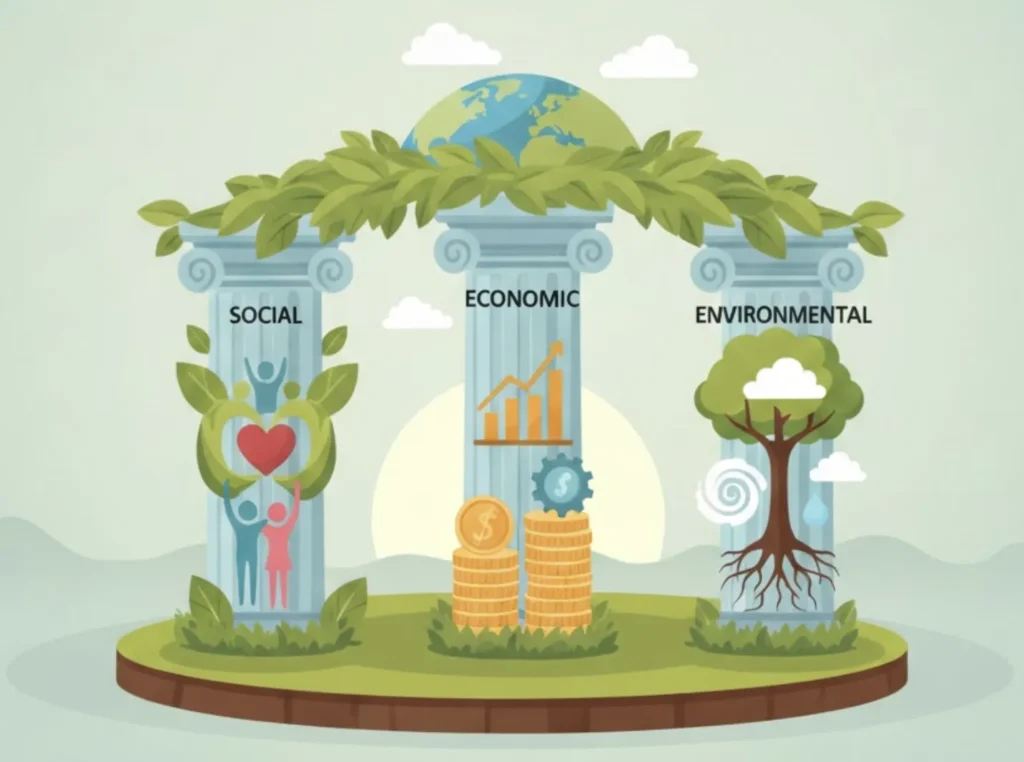
- The three pillars of...: A common way to describe the three most important parts of a concept."Sustainability is often described through the three pillars of social, economic, and environmental factors."
- Pillar of strength: Someone who provides steady emotional support during difficult times."My sister was a pillar of strength when I lost my job."

Sustainability is often described through the three pillars of social, economic, and environmental factors.
- redundancy
Redundancy (noun) /rɪˈdʌn.dən.si/:
- The state of being no longer needed or useful, often leading to a loss of a job because the position is gone. LV: atlaišana (štatu samazināšanas dēļ).
- The inclusion of extra components that are not strictly necessary but serve as a backup in case of failure. LV: dublēšana, redundance.
- The use of words or data that could be omitted without loss of meaning. LV: liekvārdība.
Example sentences:
- Due to the economic crisis, the factory announced fifty redundancies last month.
- Modern aircraft have multiple layers of redundancy in their navigation systems to ensure safety.
- You should check your essay for redundancy to make your arguments more concise.
Common phrases:
- Data redundancy: The practice of keeping the same data in two separate places to prevent loss."We use cloud storage to ensure data redundancy for our important files."
- Made redundant: To lose your job because your employer no longer needs your specific role."He was made redundant after the company automated the assembly line."
- Built-in redundancy: A backup system designed into a machine or network from the start."The hospital's power grid has built-in redundancy with three backup generators."
- mitigation
Mitigation (noun) /ˌmɪt.ɪˈɡeɪ.ʃən/:
- The action of reducing the severity, seriousness, or painfulness of something. LV: mazināšana, mīkstināšana.
- The process of making a mistake or a bad situation less damaging. LV: seku novēršana.
Example sentences:
- The city invested in better drainage as a mitigation measure against seasonal flooding.
- Effective risk mitigation involves identifying problems before they happen.
Common phrases:
- Mitigation strategy: A planned set of actions to handle potential problems."The IT team developed a mitigation strategy to handle potential server failures."
- Mitigation of damages: The legal requirement for a person to try to minimize their losses after a breach of contract."The landlord has a duty regarding the mitigation of damages by looking for a new tenant quickly."
- Climate change mitigation: Efforts to reduce or prevent the emission of greenhouse gases."Switching to solar power is a key part of climate change mitigation."
- bottleneck
Bottleneck (noun) /ˈbɒt.əl.nek/:
- A place where a road becomes narrow, or a point where traffic often stops or slows down. LV: "pudeles kakls" (šaurā vieta ceļā), sastrēguma punkts.
- A stage in a process that causes the entire process to slow down or stop. LV: kavējošais posms, vājais punkts.
Example sentences:
- The bridge construction has created a major bottleneck for morning commuters.
- We need to identify the bottleneck in the assembly line to increase our daily production.
Common phrases:
- Production bottleneck: A specific point in a manufacturing process where the flow of work is restricted."The packaging department is currently the main production bottleneck."
- Eliminate the bottleneck: To remove the obstacle that is slowing down a process."By hiring more staff, we were able to eliminate the bottleneck in customer service."
- Traffic bottleneck: A narrow point in a road system where traffic jams occur."The tunnel entrance is a well-known traffic bottleneck during rush hour."
- Contingency
Contingency (noun) /kənˈtɪn.dʒən.si/:
- A future event or circumstance which is possible but cannot be predicted with certainty. LV: neparedzēts gadījums, iespējamība.
- A provision for an unforeseen event or circumstance, such as an extra amount of money or a backup plan. LV: rīcības plāns neparedzētām situācijām, rezerve.
Example sentences:
- We must consider every contingency before we start the construction project.
- The budget includes a 10% fund to cover any contingency that might arise.
Common phrases:
- Contingency plan: A plan designed to take account of a possible future event or circumstance."The company has a contingency plan in case the main server fails."
- Contingency fund: A reserve of money set aside to cover unexpected expenses."We used the contingency fund to pay for the emergency roof repairs."
- Prepare for every contingency: To be ready for any possible outcome."A good pilot is trained to prepare for every contingency during a flight."
- breach
Breach (noun / verb) /briːtʃ/:
- An act of breaking a law, promise, agreement, or relationship. LV: pārkāpums.
- An opening or hole in a wall, fence, or line of defense. LV: pārrāvums, caurums.
- An incident where data is accessed or stolen without permission. LV: noplūde, drošības pārkāpums.
- (Verb) To break through or make a hole in something. LV: izlauzties, pārraut.
Example sentences:
- The company was sued for a breach of contract after failing to deliver the goods.
- The massive storm caused a breach in the sea wall, flooding the nearby houses.
- Security experts are investigating a massive data breach that exposed millions of emails.
- The enemy forces managed to breach the castle gates after a long battle.
Common phrases:
- Breach of trust: A failure to be honest or loyal to someone who trusts you."Sharing her private diary was a serious breach of trust."
- Security breach: An event where a security system is bypassed."The airport had a security breach when a traveler walked through a locked door."
- Breach of peace: Noisy or violent behavior in public."The protesters were arrested for breach of peace."
- Material breach: A failure to perform a contract that is serious enough to destroy the value of the deal."Failure to pay the rent for three months is a material breach of the lease."
- benefitBenefit (noun): 1. An advantage or profit gained from something. Translation: labums, ieguvums. 2. A payment made by the government or an insurance company to someone in need. Translation: pabalsts. 3. A helpful service or extra feature provided by an employer in addition to salary. Translation: papildu labums, privilēģija.Example sentences: 1. One major benefit of regular exercise is improved sleep quality. 2. She is currently receiving unemployment benefits while she looks for a new job. 3. The company offers a great benefit package, including health insurance and a gym membership.
- at odds
at odds (idiom/prepositional phrase):
- Disagreement: to be in a state of disagreement or conflict with someone.
- Inconsistency: to be different from something else when the two things should be the same or match.
synonyms: in conflict, at loggerheads, clashing, inconsistent, quarreling.
pronunciation: /æt ɒdz/
translation: nesaskaņā, pretrunā.
example: The two directors were at odds over the company's new investment strategy, leading to a very long meeting.
- reasonably
reasonably (adverb):
- in a way that is fair, sensible, or shows good judgment.
- to a satisfactory level; "fairly" or "quite"; good enough
- at a price that is not too expensive; at a fair cost.
synonyms: sensibly, logically, moderately, fairly, affordably.
pronunciation: /ˈriːz.nə.bli/
translation: saprātīgi, diezgan, mēreni.
example: The hotel was reasonably priced and very clean, so we decided to stay for an extra two nights.
other words from this root: reason (noun/verb), reasonable (adjective), unreasonable (adjective).
- at odds
at odds (idiom/prepositional phrase):
- Disagreement: to be in a state of disagreement or conflict with someone.
- Inconsistency: to be different from something else when the two things should be the same or match.
synonyms: in conflict, at loggerheads, clashing, inconsistent, quarreling.
pronunciation: /æt ɒdz/
translation: nesaskaņā, pretrunā.
examples: The two directors were at odds over the company's new investment strategy, leading to a very long meeting. He has been at odds with his neighbor ever since they argued about the garden fence.
- envoy
envoy (noun):
- Diplomacy: an official messenger or representative sent by a government on a specific mission or to represent their country in a foreign land.
- General: a person delegated to represent a group or organization to deliver a message or conduct negotiations.
synonyms: representative, ambassador, delegate, messenger, emissary.
pronunciation: /ˈenvɔɪ/
translation: sūtnis, pārstāvis
example: The United Nations sent a special envoy to the region to help negotiate a peace treaty between the two groups.
- trilateral
trilateral (adjective):
- General: involving three groups, parties, or nations.
- Geometry: having three sides (though "triangular" is more common in everyday English).
synonyms: three-way, tripartite, triple.
pronunciation: /traɪˈlæt.ər.əl/
translation: trīspusējs
example: The leaders of the three neighboring countries met to sign a trilateral agreement regarding water rights for the shared river.
other words from this root: lateral (adjective), bilateral (two-sided), quadrilateral (four-sided).
- dispatcher
dispatcher (noun):
- Logistics: a person whose job is to organize the movement of vehicles, deliveries, or workers.
- Emergency Services: the person who receives emergency calls (like 911 or 112) and sends the police, fire department, or ambulance to the correct location.
- Transportation: a person who manages the schedules of trains, buses, or airplanes to ensure they leave and arrive on time.
synonyms: coordinator, controller, sender, manager.
pronunciation: /dɪˈspætʃ.ər/
translation: dispečers, nosūtītājs.
example: The taxi dispatcher told the driver to pick up the passenger at the airport terminal.
other words from this root: dispatch (verb/noun).
Contextual Usage
- Emergency Response: The dispatcher is the "middleman" between the person in trouble and the rescuers. They must stay calm and gather information quickly."The emergency dispatcher gave me instructions on how to help the victim while the ambulance was on the way."
- Trucking and Freight: In logistics, dispatchers find loads for truck drivers and track their progress across the country."A good dispatcher knows how to plan the best route to save fuel and time."
- Public Transport: They monitor traffic and delays to make sure buses and trains stay on schedule."Due to the snowstorm, the train dispatcher had to cancel several departures for safety reasons."
- Aviation: Flight dispatchers share responsibility with the pilot for the safety of the flight, planning the fuel and checking the weather."The flight dispatcher calculated that the plane needed extra fuel because of the strong headwind."
- dispatch
dispatch (verb / noun):
- Logistics: to send off a person, vehicle, or package to a specific destination for a particular purpose.
- Emergency Services: to coordinate and send help (police, fire, ambulance) to a scene.
- Action/Task: to deal with a task or a problem quickly and efficiently.
- As a noun: an official report or message; or, the act of sending someone or something somewhere.
synonyms: (v) send, ship, transmit, execute; (n) message, bulletin, shipment.
pronunciation: /dɪˈspætʃ/
translation: nosūtīt, izsūtīt (v); ziņojums, nosūtīšana (n).
example: The warehouse manager promised to dispatch the order by the end of the day so it would arrive by morning.
other words from this root: dispatcher (noun).
Contextual Usage
- Shipping & E-commerce: Used when a package leaves the warehouse and begins its journey to the customer."You will receive an email notification once your items have been dispatched from our facility."
- Emergency Response: Refers to the central hub that receives 911/112 calls and sends the right teams to help."The operator will dispatch an ambulance to your location immediately; please stay on the line."
- Business Efficiency: Used when someone finishes a job very quickly without wasting time."She dispatched the morning's emails in record time, leaving her free to focus on the afternoon meeting."
- Military & Journalism: An official report sent from the "field" (like a war zone) back to headquarters or a newspaper."The journalist’s final dispatch from the front lines described the difficult conditions faced by the local people."
- insist
insist (verb):
- to say firmly that something is true, especially when other people do not believe you.
- to demand that something must happen or that someone must do something, and not accept "no" for an answer.
synonyms: demand, maintain, assert, command, persist.
pronunciation: /ɪnˈsɪst/
translation: uzstāt, neatlaidīgi apgalvot.
example: Although it was raining heavily, he insisted on walking to the station instead of taking a taxi.
other words from this root: insistence (noun), insistent (adjective).
- Grammar Note: "Insist" is often followed by the preposition "on" + a verb ending in -ing, or by the word "that"."He insisted on calling the manager." / "He insisted that we call the manager."
- go along with
go along with (phrasal verb):
- to agree with someone else's idea, opinion, or plan.
- to support or accept a decision, even if you do not completely agree with it or didn't think of it yourself.
- (literally) to travel or go somewhere with another person.
synonyms: agree, concur, support, comply, follow.
pronunciation: /ɡoʊ əˈlɔːŋ wɪð/
translation: piekrist, atbalstīt, iet kopā ar.
example: Even though he had some doubts, he decided to go along with the team's decision to change the project deadline.
Contextual Usage
- Business & Decisions: "The board of directors usually goes along with the CEO's recommendations for new investments."
- Social Situations: "I didn't really want to see a horror movie, but I just went along with what my friends wanted to do."
- Rules and Systems: "To get your permit approved, you must go along with all the official requirements set by the council."
- Literal Movement: "My sister is going to the dentist, and I think I'll go along with her to keep her company."
- hint (noun / verb):
- As a noun: a small piece of practical information or advice; or, a slight sign that suggests something without saying it directly.
- As a verb: to suggest something in an indirect way.
synonyms: (n) clue, tip, suggestion, pointer; (v) imply, intimate, insinuate.
pronunciation: /hɪnt/
translation: mājiens (noun); likt manīt, dot mājienu (verb).
example: If you are stuck on the crossword puzzle, I can give you a small hint to help you find the answer.
Contextual Usage
- Learning & Games: Used when someone needs help but does not want the full answer immediately."The teacher gave the students a hint about which chapter to study for the final exam."
- Communication: Used when someone is trying to say something without being rude or too direct."I've been hinting that I want to leave the party for an hour, but my friend hasn't noticed."
- Physical Signs: Describes a very small amount of something (often a smell, taste, or color)."The soup was delicious, with just a hint of lemon and fresh herbs."
- Predictions: Used when there is a small sign that something big is about to happen."The dark clouds provided the first hint of the storm that was coming later that evening."
- counter
counter (verb / noun / adverb):
- As a verb: to act in opposition to something; to offer a different opinion or a new offer in a negotiation.
- As a noun: a long, flat surface in a shop, bank, or kitchen; or, an action taken to oppose a move by an opponent.
- As an adverb: in the opposite direction or in conflict with something else.
synonyms: (v) oppose, resist, retaliate; (n) surface, tabletop; (adv) contrary, against.
pronunciation: /ˈkaʊn.tər/
translation: pretoties, atspēkot (verb); lete, galds (noun).
example: After the company offered him a lower salary, he decided to counter with a request for more vacation days.
other words from this root: counteract (verb), counter-attack (noun/verb).
Contextual Usage
- Business & Negotiation: Used when you receive a proposal and respond with your own terms."The buyer made an offer of €200,000, and the seller countered at €220,000."
- Arguments & Debates: Used when you provide a fact or idea that proves someone else is wrong."She countered his argument by showing the latest sales figures, which proved the project was actually successful."
- In the Home/Retail: Refers to the physical surface where work is done or items are sold."Please leave the keys on the kitchen counter before you leave."
- Sports & Games: A move made to defend against an attack and immediately start your own."The boxer waited for his opponent to miss and then delivered a powerful counter-punch."
- General Direction: Used to describe something going against the normal trend."His decision to quit a high-paying job to travel went counter to his family's expectations."
- tariffs
tariff (noun):
- Trade: taxes imposed by a government on goods imported from other countries.
- Services: a list of fixed prices for services, such as electricity, public transport, or hotel rooms.
synonyms: taxes, duties, levies, charges, fees.
pronunciation: /ˈtær.ɪfs/
translation: tarifi, muitas nodokļi
example: The government decided to increase tariffs on imported steel to encourage citizens to buy from local factories.
other words from this root: tariff (singular noun/verb).
Contextual Usage
- International Trade: Tariffs are used as a tool to protect domestic industries by making foreign products more expensive."The ongoing trade war led to higher tariffs on electronics, which increased the price for the average consumer."
- Utilities and Bills: Refers to the specific rate you pay for a service."I switched to a different energy provider because they offered a cheaper fixed-rate tariff for electricity."
- History: Historically, tariffs were a primary source of income for many countries before income taxes became common."The 1930s saw a surge in protective tariffs as nations tried to shield their economies from the global depression."
- Travel and Tourism: Used to describe the official price list for services like train tickets or hotel stays."The hotel tariff is significantly higher during the peak summer season than in the winter."
- impose
impose (verb):
- Rules/Laws: to officially force a rule, tax, or punishment to be obeyed.
- Beliefs: to force someone to accept your ideas or way of life.
synonyms: enforce, dictate, inflict, foist, burden.
pronunciation: /ɪmˈpəʊz/
translation: uzlikt (piem. nodokli), uzspiest (viedokli), apgrūtināt.
example: The government decided to impose a new tax on plastic packaging to reduce environmental waste.
other words from this root: imposition (noun), imposing (adjective).
Contextual Usage
- Government and Legal: "The city council plans to impose a ban on cars in the historic center during weekends."
- Social Manners: "I don't want to impose on you, but would it be possible to stay at your house for one night?"
- Leadership and Parenting: "A good manager listens to the team instead of trying to impose their personal style on everyone."
- Architecture/Appearance: The adjective form (imposing) describes something that looks very big, impressive, or a bit scary."The old bank building was very imposing, with its massive stone columns and heavy iron doors."
- threaten
threaten (verb):
- General: to tell someone that you will kill or hurt them, or cause them problems, if they do not do what you want.
- Situational: to be a danger to something or to be likely to cause harm or a bad result.
synonyms: endanger, imperil, intimidate, menace, browbeat.
pronunciation: /ˈθret.n/
translation: draudēt, apdraudēt
example: The sudden change in weather began to threaten the success of the outdoor harvest festival.
other words from this root: threat (noun), threatening (adjective), threateningly (adverb).
Contextual Usage
- Safety and Crime: "The kidnappers threatened to harm the victim if the ransom was not paid immediately."
- Environmental/Nature: "Pollution and rising sea levels threaten the survival of many coastal bird species."
- Business and Economy: "High interest rates threaten to slow down the growth of small businesses this year."
- Meteorology: "Dark, heavy clouds were threatening rain all afternoon, so we decided to stay indoors."
- allies
allies (noun, plural):
- Political/Military: countries that have agreed to help and support each other, especially during a war.
- Social/General: people or groups that help and support you, especially when others are against you or when you are trying to achieve a difficult goal.
synonyms: partners, supporters, associates, collaborators, confederates.
pronunciation: /ˈælaɪz/
translation: sabiedrotie
example: During the trade negotiations, the two small countries acted as allies to protect their local farmers.
other words from this root: (singular noun/verb), alliance (noun), allied (adjective).
Contextual Usage
- Geopolitics: Refers to formal agreements between nations (like NATO members)."The country called on its allies for military support after the border was attacked."
- The Workplace: Describes colleagues who support your ideas or help you during a disagreement."If you want the manager to change the schedule, you will need to find some allies in other departments first."
- Social Justice: Refers to a person who supports a group they do not belong to (for example, a man supporting women's rights)."To create a fair workplace, it is important for everyone to be allies for diversity and inclusion."
- Nature/Biology: Used to describe different species that help each other survive (symbiosis)."In the garden, certain insects are the farmer's allies because they eat the pests that destroy crops."
- acquire
acquire (verb):
- General: to get or obtain something, especially something that requires effort or money.
- Business: to buy or take control of a company or an asset.
- Skills/Knowledge: to learn or develop a specific ability or habit over time.
synonyms: obtain, gain, attain, procure, purchase.
pronunciation: /əˈkwaɪər/
translation: iegūt, apgūt, nopirkt (uzņēmumu)
example: The company plans to acquire its smaller rival to expand its market share in Europe.
other words from this root: acquisition (noun), acquisitive (adjective).
Contextual Usage
- Skills and Language: Used when a person learns something naturally or through practice."It takes several years to acquire a high level of fluency in a foreign language."
- Business and Finance: Refers to "Mergers and Acquisitions" (M&A). It is the formal word for one company buying another.
- Physical Objects: Often used for large or expensive items, such as land, art, or equipment."The museum was able to acquire a rare painting by Rembrandt for its permanent collection."
- Medical/Scientific: Used when someone "catches" a disease or develops a trait."Some bacteria acquire resistance to antibiotics over many generations."
- tensions
tensions (noun, plural):
- Emotional/Social: feelings of worry, anger, or a lack of trust between people, groups, or countries that are in conflict.
- Physical: the state of being stretched tight, or a feeling of stiffness and pressure in the muscles.
synonyms: (emotional) friction, unease, strain; (physical) tightness, pressure.
pronunciation: /ˈten.ʃənz/
translation: saspīlējums, spriedze
example: Tensions between the two departments increased after the budget was cut and everyone had to work longer hours.
other words from this root: tension (singular), tense (adjective/verb).
Contextual Usage
- Workplace & Social: Used to describe the "atmosphere" in a room when people are arguing or uncomfortable."You could feel the tension in the air during the meeting."
- Physical Health: Often used to describe pain caused by stress, usually in the neck, back, or head."I always get tension headaches when I spend too much time staring at a screen."
- Physics & Engineering: Refers to the force transmitted through a string, rope, or wire when it is pulled tight by forces acting from opposite ends."The engineer calculated the tension on the bridge cables to ensure they wouldn't snap."
- Prick up your ears
prick up your ears (idiom): to suddenly start listening very carefully because you have heard something interesting, surprising, or important.
synonyms: listen intently, be all ears, pay close attention
pronunciation: /prɪk ʌp jɔːr ɪərz/
translation: saspicēt ausis
example: The mention of a pay rise made everyone prick up their ears.
Origin and Imagery
The phrase comes from the behavior of animals (like dogs, horses, or rabbits).
- bipartisan
bipartisan (adjective): involving the agreement or cooperation of two political parties that usually oppose each other's policies.
synonyms: cross-party, dual-party, cooperative, non-partisan (though slightly different).
pronunciation: /baɪˈpɑːr.tɪ.zən/
translation: divpusējs, abpusējs (starp divām partijām), abpartiju
example: The new infrastructure bill passed with bipartisan support, receiving votes from both Democrats and Republicans.
other words from this root: bipartisanship (noun).
Understanding the Concept
In a two-party system (like in the United States), most issues are "partisan," meaning the parties disagree. When a "bipartisan" agreement occurs, it suggests that the issue is so important or the solution so logical that both sides have set aside their rivalry to work together.
Bipartisan vs. Non-partisan vs. Unanimous
It is easy to confuse these terms, but they describe different levels of agreement:
Term Meaning Example Bipartisan Two opposing parties agree. A law co-sponsored by a liberal and a conservative. Non-partisan Not biased toward any political group. A judge or a charity that stays out of politics. Unanimous Everyone agrees (100%). A jury deciding a verdict or a club choosing a leader. - corrugated
corrugated (adjective): shaped into a series of parallel ridges and grooves (waves) to provide added strength, rigidity, or to facilitate the drainage of liquid.
synonyms: fluted, grooved, ridged, furrowed, wavy. pronunciation: /ˈkɒr.ə.ɡeɪ.tɪd/ translation: gofrēts, viļņots example: The temporary shelter was constructed using sheets of corrugated iron for the roof. other words from this root: corrugation (noun), corrugate (verb).
Why Corrugate?
The primary reason for corrugating a material is to increase its strength-to-weight ratio. A thin, flat sheet of material is easy to bend; however, once it is folded into a "wave" pattern, it becomes much more resistant to bending along the direction of the ridges.
Common Applications
- Corrugated Fiberboard (Cardboard): This is the material used for most shipping boxes. It consists of a "fluted" (wavy) inner layer sandwiched between two flat "liner" layers.
- Corrugated Steel/Iron: Used extensively in roofing and siding, especially for industrial buildings and shipping containers. It is durable and allows rainwater to run off easily through the channels.
- Corrugated Plastic: Often used for temporary signs (like election posters) because it is lightweight and weather-resistant.
- Corrugated Hoses/Tubing: Used in medical equipment (like ventilators) or vacuum cleaners because the ridges allow the tube to bend without kinking or collapsing.
Comparison: Corrugated vs. Ribbed
While they look similar, they are used differently in engineering:
Term Structure Purpose Corrugated The entire material is folded into a wave shape. Structural rigidity and lightness. Ribbed A flat surface with raised lines added to it. Grip, heat dissipation, or localized reinforcement. Technical Terms
- Pitch: The distance between two peaks of the waves.
- Depth: The height from the bottom of the groove to the top of the ridge.
- Fluting: The specific name for the wavy part inside a cardboard...
- dunnage
dunnage (noun): loose materials used to support and protect cargo during shipping and storage. It prevents movement, provides cushioning, and keeps goods away from moisture or the floor.+1
synonyms: padding, bracing, packing, shims.
pronunciation: /ˈdʌn.ɪdʒ/
translation: stivējuma materiāli, pakšas, starplikas
example: The crew used heavy timber dunnage to secure the steel coils and prevent them from shifting during the sea voyage.
Primary Functions
In logistics, construction, and the military (such as in an AHA), dunnage serves three main purposes:
- Stability: Filling empty spaces (voids) between items so they don't slide when a truck brakes or a ship rolls.
- Protection: Acting as a buffer to prevent crates or machinery from scratching or denting each other.
- Moisture Control: Lifting cargo off the floor of a container or the ground to prevent water damage and allow for ventilation.
Common Types of Dunnage
The material used depends on the weight of the cargo and the mode of transport.
Material Description Common Use Timber/Lumber Solid wood beams or planks. Bracing heavy machinery or steel pipes in ships. Inflatable Air Bags Heavy-duty plastic bags filled with air. Filling "voids" in shipping containers to keep pallets steady. Corrugated Paper Layered cardboard or paper sheets. Light protection for electronics or fragile consumer goods. Foam/Plastic Custom-molded inserts. High-end protection for sensitive instruments. In Military & Construction Contexts
As mentioned in the context of an AHA (Ammunition Holding Area), dunnage is critical for safety:
- Separation: It ensures that ammunition crates are not in direct contact with the soil, preventing rot in wooden crates or rust in metal ones.
- Airflow: It allows air to circulate under the stacks, which helps maintain a stable temperature for the explosives inside.
"Dunnage" in Modern Travel
In recent years, the term has also been used in the airline industry to...
- Ammunition Holding Area [AHA]
AHA (noun/abbreviation): Stands for Ammunition Holding Area. It is a temporary or semi-permanent location used for the storage of ammunition and explosives, typically in a field environment or a military installation, while they await further distribution or use.
synonyms: Ammo dump, ASP (Ammunition Supply Point), magazine area.
pronunciation: /ˌeɪ.eɪˈtʃeɪ/
translation: Munīcijas novietne, munīcijas glabāšanas zona.
example: The unit established a mobile AHA two kilometers behind the front line to ensure a steady supply of mortar rounds.
Safety and Structure
An AHA is not just a pile of crates; it is a highly regulated space governed by strict safety protocols to prevent catastrophic accidents.
- Berming (Earthworks): Large mounds of earth are often built around storage sites. If one pile of ammo explodes, the berm directs the blast upward rather than sideways, preventing a "chain reaction" (sympathetic detonation) in neighboring piles.
- Q-D (Quantity-Distance): These are calculated safety margins. Ammunition is spaced out specifically so that the "Net Explosive Weight" (NEW) of one area won't destroy the next area if ignited.
- Compatibility Groups: Different types of explosives cannot be stored together. For example, detonators (which are sensitive) are kept far away from main artillery shells.
Key Features of an AHA
Feature Purpose Lightning Protection Preventing static or lightning strikes from igniting propellants. Firebreaks Strips of cleared land to prevent wildfires from reaching the ammo. Surveillance/Security Constant guard to prevent theft or sabotage. Dunnage Wooden pallets or materials used to keep ammo crates off the wet ground. AHA vs. ASP
While the terms are similar, they differ in scale and permanence:
- ASP (Ammunition Supply Point): A larger, more permanent hub that receives ammo from a national depot and distributes it to smaller units.
- AHA (Ammunition Holding Area): Usually smaller and closer to...
- Commissioning phase
Commissioning phase (noun phrase): The final stage of a construction or engineering project where systems (mechanical, electrical, plumbing, etc.) are tested and verified to ensure they function according to the design intent and the owner's requirements.
synonyms: Startup phase, validation phase, systems testing.
translation: Nodošana ekspluatācijā (fāze), sistēmu pārbaudes fāze.
example: During the commissioning phase, the engineers discovered that the backup generators were not kicking in fast enough to support the hospital’s critical care unit.
The Goal of Commissioning
Think of commissioning as a "quality assurance" process. It is the bridge between completion (building something) and operation (using it).
Key Activity Purpose Functional Testing Making sure equipment actually turns on and behaves correctly. System Integration Ensuring different systems (like fire alarms and ventilation) talk to each other. Performance Verification Checking if the building meets energy efficiency or safety standards. Operator Training Teaching the maintenance staff how to run the new equipment. The Typical Workflow
Commissioning usually follows a strict sequence to ensure nothing is missed before the building is handed over to the owner:
- Pre-functional Checklist: Checking that equipment is installed correctly and has power.
- Startup: Turning the machines on for the first time under controlled conditions.
- Functional Performance Tests (FPT): Running the systems through their "full range" (e.g., testing the heater at maximum capacity).
- TAB (Testing, Adjusting, and Balancing): Specifically for HVAC and water systems to ensure flow is equal in all parts of the building.
- Final Report: Documentation proving everything works, which is often required for insurance or legal reasons.
Commissioning vs. Decommissioning
- Commissioning: Bringing a new system into service.
- Decommissioning: Taking an old or dangerous system out of service...
- ductwork
ductwork (noun): a system of ducts (tubes or channels) used to move air for heating, ventilation, and air conditioning (HVAC) throughout a building.
synonyms: air ducts, ventilation system, conduits.
pronunciation: /ˈdʌkt.wɜːk/
translation: gaisvadu sistēma, ventilācijas caurules
example: The office was too hot because the ductwork was poorly insulated and leaking cool air into the attic.
Components and Materials
Ductwork is the "arteries" of a building's climate control system. It can be made from several different materials depending on the need for durability or flexibility.
Material Description Common Use Galvanized Steel Rigid metal ducts; very durable and smooth for airflow. Main trunks in residential and commercial buildings. Flexible Duct Tube-shaped wire coil covered in plastic; easy to install in tight spaces. Connecting rigid ducts to individual room vents. Fiberglass Duct Board Rigid boards with built-in insulation. Used where sound dampening and temperature control are priorities. How It Works
Ductwork operates on a "supply and return" cycle:
- Supply Ducts: Carry conditioned air (heated or cooled) from the HVAC unit to the rooms.
- Return Ducts: Pull air from the rooms back to the unit to be filtered and re-conditioned.
Common Issues
- Leaks: Holes or loose connections can waste up to 30% of energy.
- Poor Insulation: Causes air to lose its temperature before it reaches the room.
- Blockages: Dust, debris, or even pests can restrict airflow, making the system work harder.
Fun Fact: Duct Tape
Despite its name, traditional silver "duct tape" is actually not recommended for sealing ductwork because the adhesive dries out too quickly under constant temperature changes. Professionals use foil tape or mastic sealant instead.
- surge
surge (noun/verb):
- As a noun: A sudden powerful forward or upward movement, especially by a crowd, a natural force (like water), or an electrical current.
- As a verb: To move suddenly and powerfully forward or upward; to increase suddenly.
synonyms: (n) rush, flood, spike, outburst; (v) soar, swell, gush, escalate.
pronunciation: /sɜːrdʒ/
translation: straujš pieaugums, uzplūds, sprieguma lēciens
example: There was a sudden surge in the crowd as the gates opened and everyone tried to get the best seats.
other words from this root: surging (adjective).
Contextual Usage
- Electrical: A "power surge" is a brief spike in voltage that can damage electronics. This is why people use "surge protectors."
- Weather/Nature: A "storm surge" is a rising of the sea as a result of atmospheric pressure changes and wind associated with a storm.
- Medical: A "surge of adrenaline" describes a sudden feeling of energy or excitement in the body.
- Economic: "There has been a surge in demand for electric vehicles over the last year."
Surge vs. Spike
While both indicate an increase, they have slightly different shapes on a graph:
- Spike: A very sharp, narrow increase that usually drops back down immediately.
- Surge: A powerful, broader increase that may stay at a high level for a short period before receding.
Type of Increase Visual Shape Typical Example Spike Like a needle A stock price jumping for 5 minutes. Surge Like a wave A flood of people entering a stadium. Common Phrases
- Surge pricing: When a service (like Uber) increases its rates during times of high demand.
- A surge of emotion: A sudden, strong feeling of joy, anger, or sadness.
- Adrenaline surge: The physical "fight or flight" response.
- tender
tender (noun/verb/adjective):
- As a noun (Business): A formal offer to carry out work, supply goods, or buy an asset at a stated fixed price.
- As a verb (Action): To formally offer or present something (e.g., to "tender a resignation" or "tender a payment").
- As an adjective (Feeling): Showing gentleness, kindness, or affection; or describing food that is easy to chew.
synonyms: (n) bid, proposal, offer; (v) submit, proffer; (adj) soft, delicate, sore.
pronunciation: /ˈtendə/
translation: n: konkurss, piedāvājums; v: iesniegt; adj: maigs, jēls (sāpīgs)
example: The construction company submitted a tender for the new bridge project.
1. Business & Procurement (The "Tendering" Process)
In a business context, a "tender" is the response to an RFP or IFB. It is the actual package of documents where you promise to do the work for a specific price.
Term Meaning Open Tender Anyone is allowed to submit a bid. Closed/Restricted Tender Only invited or pre-qualified companies can bid. Competitive Tendering A process where multiple companies "fight" to offer the best price and quality. 2. Legal & Formal Use (Verbs)
"To tender" means to offer something formally so that it can be accepted or rejected.
- Tender a resignation: To formally give your boss a letter saying you are quitting.
- Legal Tender: Coins or banknotes that must be accepted if offered in payment of a debt.
- Tender of performance: An offer to do what one is required to do under a contract.
3. Physical & Emotional (Adjective)
- Physical: "My arm is still tender where I got the flu shot." (It hurts when touched).
- Cooking: "The steak was so tender you could cut it with a fork."
- Emotional: "He gave her a tender look before saying goodbye."
Tender vs. Bid
While often used as synonyms, there is a slight technical difference in some regions:
- Bid: More common in the US and in auctions (buying something).
- Tender: More common in the UK, Commonwealth,...
- IFB / CFB / RFB [IFB]
IFB (Invitation for Bids) / CFB (Call for Bids) / RFB (Request for Bids)
These are formal invitations to vendors to submit a priced bid for specific goods or services. They are common in government and construction sectors.
- Synonyms: Sealed bidding, competitive bidding, tender.
- Translation: Iepirkuma konkurss, uzaicinājums iesniegt piedāvājumu.
- Example: "The Ministry of Transport issued an IFB for the supply of 500 tons of road salt."
How it differs from an RFP
In an RFP, the buyer says: "I have a problem; tell me how you would solve it."
In an IFB/RFB, the buyer says: "I need exactly these items; tell me your lowest price."
Feature RFP (Proposal) IFB/RFB (Bid) Goal Find the best solution Find the lowest price Flexibility High (vendors suggest methods) Low (specifications are fixed) Evaluation Quality, experience, and price Lowest responsive and responsible bidder Negotiation Common after submission Usually prohibited; bids are "sealed" Key Terms to Know
- Sealed Bid: A process where all bidders submit their prices at the same time, and no one sees the prices until a specific "bid opening" date to prevent cheating.
- Responsive Bidder: A company that followed all the instructions in the bid document (filled out the forms correctly, met the deadline).
- Responsible Bidder: A company that actually has the money, equipment, and skill to do the work.
- SOW (Statement of Work): In an IFB, this section is extremely detailed because the vendor must follow it exactly.
When to use an IFB/RFB
Use this method when:
- The project is clearly defined (e.g., buying standard office chairs).
- There is no need for creative solutions or technical discussion.
- Price is the only or primary factor for the decision.
- Request for Proposals [RFP]
RFP (noun/abbreviation): Stands for Request for Proposals. It is a formal business document that announces a project, describes it, and invites qualified vendors or contractors to submit bids to complete the work.
synonyms: Tender, bid invitation, solicitation.
translation: piedāvājuma pieprasījums
example: The city council issued an RFP to find a construction firm capable of building the new library within a two-year timeframe.
The RFP Process
An RFP is used when a project is complex and requires more than just a price quote. The buyer is looking for the best solution, not just the lowest cost.
Stage Action Drafting The organization defines the project goals, scope, and technical requirements. Issuance The document is sent to specific vendors or published publicly. Evaluation The buyer compares the proposals based on a "scorecard" (experience, price, timeline). Selection A winning vendor is chosen and contract negotiations begin. RFP vs. RFI vs. RFQ
Businesses often use different "RF-x" documents depending on what they need to know:
- RFI (Request for Information): "I have a problem, tell me what solutions exist." (Research phase).
- RFQ (Request for Quotation): "I know exactly what I want (e.g., 500 laptops), tell me your best price." (Price-focused).
- RFP (Request for Proposal): "I have a goal, tell me how you would achieve it and what it will cost." (Strategy-focused).
Key Components of an RFP
- Statement of Work (SOW): A detailed description of the tasks to be performed.
- Selection Criteria: How the winner will be picked (e.g., 40% experience, 30% price, 30% technical plan).
- Timeline: Deadlines for questions, the proposal submission, and the project start date.
- blast
blast (noun/verb):
- As a noun: a sudden, powerful explosion or a strong gust of wind; informally, it refers to a very enjoyable experience.
- As a verb: to blow something up with explosives, or to produce a very loud noise. Figuratively, it means to criticize someone severely.
synonyms: (n) explosion, gust, gale, (slang) thrill; (v) detonate, shatter, roar, lambast.
pronunciation: /blɑːst/
translation: n: sprādziens, brāzma, jautrība; v: uzspridzināt, dārdēt, asi kritizēt
example: The construction crew had to blast through the solid rock to create the tunnel.
Contextual Usage
- Physical/Industrial: "A blast of cold air hit me as soon as I opened the door."
- Entertainment (Slang): "We had a blast at the party last night!" (Meaning: we had a great time).
- Music/Sound: "Stop blasting your music; the neighbors are complaining!"
- Criticism: "The media blasted the director for his controversial remarks."
- bloat
bloat (noun/verb):
- As a verb: to swell up or become large/distended, typically with fluid, gas, or unnecessary data.
- As a noun: an undesirable state of being swollen; in computing, it refers to software that is slow or uses too much memory because of unnecessary features.
synonyms: (v) swell, puff up, expand; (n) distension, excess, redundancy.
pronunciation: /bloʊt/
translation: v: uzpūsties, pietūkt; n: uzpūšanās, pārmērība
example: Eating too much salt can cause your body to bloat because it makes you retain water.
other words from this root: bloated (adjective), bloating (noun).
Contextual Usage
- Medical/Biology: "I feel bloated after that heavy meal." This usually refers to abdominal discomfort caused by digestive gas.
- Computing/Software: "Software bloat" (or bloatware) refers to programs that include so many useless features that they become slow and occupy too much disk space.
- Economics/Management: "The company suffered from bureaucratic bloat, with too many middle managers and not enough workers."
- counter with
to counter with (phrasal verb): to respond to a move, an argument, or an offer with one of your own, usually to defend yourself or to gain an advantage.
synonyms: to retaliate with, to respond with, to rebut.
pronunciation: /tuː ˈkaʊntə wɪð/
translation: atbildēt ar, likt pretī, stāties pretī ar
example: After the union demanded a 10% pay rise, the management decided to counter with an offer of 5% and better health benefits.
other words from this root: counter (noun/adjective/verb/adverb), counteract (verb).
Contextual Usage
- Negotiations: "They asked for a high price, so we countered with a much lower bid."
- Arguments/Debates: "She claimed the project was over budget, but he countered with data showing they had actually saved money."
- Sports/Physical: "The boxer blocked the punch and countered with a quick left hook."
- denounce
denounce (verb): to publicly declare something to be wrong or evil; to strongly criticize someone or something in a formal way. It can also mean to inform authorities about someone’s illegal or immoral activities.
synonyms: condemn, criticize, censure, vilify, expose.
pronunciation: /dɪˈnaʊns/
translation: nosodīt, atmaskot or uzrādīt
example: The government was quick to denounce the terrorist attack, calling it a "cowardly act against innocent civilians."
other words from this root: denunciation (noun), denouncer (noun).
Contextual Usage
- Political/Public: "The United Nations voted to denounce the invasion of the sovereign territory."
- Moral/Ethical: "The whistleblower chose to denounce the company's corrupt practices to the press."
- Legal/Historical: In some historical contexts, it means to formally end a treaty or agreement.
Denounce vs. Criticize
While they both involve saying something is bad, denounce is much more powerful:
- Criticize: Can be mild or constructive (e.g., "I criticize your grammar").
- Denounce: Is usually a total rejection based on moral or legal grounds (e.g., "I denounce your hateful ideology").
- steer away from
steer away from (phrasal verb): to avoid someone or something, or to change the direction of a conversation or action to avoid a specific topic or situation.
synonyms: avoid, sidestep, evade
pronunciation: /stɪər əˈweɪ frɒm/
translation: izvairīties no, turēties pa gabalu no
example: The doctor advised him to steer away from fatty foods if he wanted to lower his cholesterol levels.
Contextual Usage
- Social/Interpersonal: "I try to steer away from my neighbor when he's in a bad mood."
- Conversation: "When the interview got too personal, she skillfully steered away from the topic and back to her professional achievements."
- Strategy/Business: "The company decided to steer away from traditional advertising and focus entirely on social media influencers."
- sound
sound (noun) /saʊnd/: something that you hear.
translations: skaņa, troksnis
examples: I love the sound of the ocean in the morning. Please turn down the sound on the television; it is too loud."
***
sound (verb) /saʊnd/: to seem or give a specific impression when you hear or read something; also, to make a noise or to ring an alarm.
translations: izklausīties, likties (pēc dzirdētā/ lasītā); atskanēt
examples: That sounds like a great idea! Let's do it. The siren will sound if there is an emergency in the building.
***
sound (adjective): (of an argument or reasoning) logically valid and based on true premises. If an argument is "sound," it means the reasoning is flawless and the facts it relies on are accurate.
synonyms: logical, valid, robust, cogent, reliable, well-founded.
pronunciation: /saʊnd/
translation: pamatots, loģisks, uzticams
example: While her conclusion was surprising, her sound arguments made it impossible for the board to disagree with her.
Example of a Sound Argument:
- Premise 1: All humans are mortal. (True)
- Premise 2: Socrates is a human. (True)
- Conclusion: Therefore, Socrates is mortal. (Logically follows)
- Result: This argument is Sound.
Other Uses of "Sound"
Outside of logic, "sound" implies stability and health:
- Sound advice: Good, practical advice you can trust.
- Safe and sound: To be completely safe and uninjured.
- A sound sleeper: Someone who sleeps deeply and isn't easily woken.
- Financially sound: A company or person with a healthy bank balance and no dangerous debts.
- deflect
deflect (verb): to cause something to change direction; or, figuratively, to turn away a question, blame, or criticism toward someone or something else.
synonyms: divert, sidetrack, parry, avert, pivot.
pronunciation: /dɪˈflekt/
translation: novirzīt, atvairīt, novērst
example: The politician tried to deflect the reporter's question about the scandal by talking about the improving economy instead.
other words from this root: deflection (noun), deflector (noun).
Contextual Usage
- Physical: "The goalkeeper managed to deflect the ball with his fingertips, sending it over the crossbar."
- Psychological/Social: "When I asked him why the project was late, he tried to deflect the blame onto the IT department."
- Scientific: "Magnetic fields can deflect the path of charged particles."
- substantial
substantial (adjective): large in size, value, amount, or importance; also used to describe something that is strongly built or "solid."
synonyms: considerable, significant, sizable, hefty, solid, meaningful.
pronunciation: /səbˈstænʃl/
translation: būtisks, ievērojams, pamatīgs or apjomīgs
example: After the new marketing campaign, the company saw a substantial increase in its monthly sales.
other words from this root: substantially (adverb), substance (noun), substantiate (verb).
- demagogue
demagogue (noun): a political leader who seeks support by appealing to the desires and prejudices of ordinary people rather than by using rational argument.
synonyms: firebrand, rabble-rouser, provocateur, populist (in certain contexts).
pronunciation: /ˈdem.ə.ɡɒɡ/
translation: demagogs
example: The historian described the leader as a demagogue who used fear and nationalistic rhetoric to consolidate power during the economic crisis.
other words from this root: demagoguery (noun), demagogic (adjective).
- excessively
excessively (adverb): to a greater degree or in greater amounts than is necessary, normal, or desirable. It implies that a limit has been crossed.
synonyms: exceedingly, immoderately, disproportionately, overly, inordinately.
pronunciation: /ɪkˈsesɪvli/
translation: pārmērīgi, pārlieku or pārlieki
example: The manager was criticized for being excessively harsh when pointing out minor mistakes to his staff.
Nuance: "Very" vs. "Excessively"
While "very" simply increases the intensity, excessively almost always carries a negative connotation, suggesting that the amount is "too much" and causing a problem.
Common Collocations
- Excessively high/low: Used often with prices, temperatures, or speeds.
- Drink excessively: A formal or medical way to describe consuming too much alcohol.
- Excessively long: Describing a speech, a line, or a waiting period that feels unreasonable.
Comparison Table
Word Tone Implication Very Neutral High intensity. Extremely Strong Highest intensity. Excessively Critical More than is healthy or allowed. Related Terms
- Exorbitant: Used specifically for prices or fees that are excessively high.
- Redundant: Something that is excessive because it is no longer needed or is a duplicate.
would you like me to explain the word "superfluous" (extra and unnecessary) or perhaps the term "moderation" (the opposite of excess)?
- don’t sweat it
don't sweat it (idiom / informal): a phrase used to tell someone not to worry or be anxious about something. It is a way of saying "it’s not a big deal" or "don't worry".
synonyms: don't worry about it, no biggie, no stress, forget about it.
pronunciation: /doʊnt swɛt ɪt/
translation: neuztraucies, neņem galvā, nieks par to
example: "I’m so sorry I forgot to return your book today!" — "Don't sweat it, I don't need it back until next week anyway."
Usage and Tone
This is a very casual and reassuring phrase. It is best used with friends, family, or colleagues in relaxed environments. You would typically use it in two situations:
- After an apology: To show you aren't angry.
- When someone is stressed: To encourage them to relax about a minor problem.
The "Anxiety" Scale
"Don't sweat it" is used for low-to-medium level concerns. For very serious life issues, it might sound a bit too dismissive.
Related Phrases
Phrase Context No sweat Used to say that a task was very easy to do. ("Can you fix this?" "Sure, no sweat!") Don't break a sweat To do something without much effort. Sweating the small stuff Worrying about tiny, unimportant details. - hazardous
hazardous (adjective): involving risk or danger, especially to someone's health or safety.
synonyms: dangerous, risky
pronunciation: /ˈhæzədəs/
translation: bīstams, riskants, veselībai kaitīgs
example: The firefighters had to wear specialized suits to enter the building because of the hazardous chemical fumes.
other words from this root: hazard (noun), haphazard (adjective).
Contextual Usage
- Environment: "Hazardous waste" refers to garbage (like batteries, oils, or medical supplies) that can harm the environment if not disposed of correctly.
- Weather: "The icy roads created hazardous driving conditions for the morning commute."
- Workplace: "Occupational hazards" are risks specifically associated with a certain job, such as falling for a construction worker or strain for a desk worker.
Common Types of Hazards
In safety management, hazards are often categorized to help people identify risks:
Category Examples Biological Viruses, bacteria, mold. Chemical Cleaning fluids, acids, pesticides. Physical Noise, radiation, extreme heat. Ergonomic Poor workstation setup, heavy lifting. - chemicals
chemicals (noun): substances with a distinct molecular composition that are produced by or used in a chemical process. In a broader sense, everything made of matter is composed of chemicals.
synonyms: substances, compounds, elements, reagents.
pronunciation: /ˈkemɪklz/
translation: ķimikālijas, ķīmiskas vielas
example: The laboratory has strict safety protocols for handling hazardous chemicals.
other words from this root: chemistry (noun), chemist (noun), chemical (adjective), chemically (adverb).
Classification
In everyday language, people often use "chemicals" to refer to synthetic or "unnatural" substances, but scientifically, water (H2O) and oxygen (O2) are also chemicals.
- reduce
reduce (verb): to make something smaller or less in size, amount, degree, or importance.
synonyms: decrease, lessen, diminish, cut, curtail.
pronunciation: /rɪˈdjuːs/
translation: samazināt, mazināt, reducēt
example: The company is trying to reduce its carbon footprint by switching to renewable energy sources.
other words from this root: reduction (noun), reducible (adjective), reduced (adjective).
Contextual Usage
- Cooking: To boil a liquid (like a sauce) so that it becomes thicker and more concentrated. ("Simmer the sauce for ten minutes to reduce it.")
- Mathematics: To change a fraction to its simplest form. ("You can reduce 4/8 to 1/2.")
- Sustainability: Part of the "Three Rs"—Reduce, Reuse, Recycle.
Common Collocations
Phrase Meaning Reduce to tears To make someone cry. Reduce to rubble To completely destroy a building or city. Reduced price A lower price than usual (a discount). - Tech
tech (noun / adjective): a common abbreviation for technology or technician. It is used to describe the industry, the tools, or the people working within fields like computing, engineering, and electronics.
synonyms: technology, electronics, IT (Information Technology), machinery, gear.
pronunciation: /tek/
translation: tehnoloģijas (industry), tehniķis (person), tehnisks (adjective)
example: The city has become a major tech hub, attracting thousands of software developers and startups every year.
other words from this root: technical (adj), technique (noun), technician (noun), high-tech (adj).
Common Contexts
- The Tech Industry: Refers to companies like Google, Apple, or local startups (e.g., "I want to get a job in tech").
- Big Tech: Refers to the most dominant global technology companies (Amazon, Alphabet, Meta, etc.).
- Tech-savvy: Describes someone who is very proficient or comfortable using modern technology.
- A Tech: Informal shorthand for a technician (e.g., "The lab tech is running the blood tests now").
Different "Tech" Roles
Role Responsibility FinTech Financial technology (apps like Revolut or PayPal). EdTech Educational technology (platforms like Duolingo or Coursera). MedTech Medical technology (robotic surgery, pacemakers, etc.). CleanTech Technology used to improve environmental sustainability. - treat
treat (verb/noun):
- As a verb: to behave toward or deal with someone in a particular way; or to give medical care to someone.
- As a noun: something special that you buy or do for someone (or yourself) that gives pleasure.
synonyms: (v) handle, manage, attend to; (n) delight, bonus.
pronunciation: /triːt/
translation: v: izturēties, ārstēt, cienāt; n: kārums, prieks, baudījums
Contextual Usage
- Behavior: "You should treat others the way you want to be treated."
- Medical: "The doctor is treating her for a persistent cough."
- Hospitality/Gift: "I'll treat you to lunch since it's your birthday." (meaning: I will pay for it).
- Noun: "After a long week of work, a spa day was a real treat."
Other words from this root
- Treatment (noun): the way you deal with someone, or medical care.
- Treatable (adjective): (of an illness) capable of being cured or managed.
- Mistreat (verb): to treat someone badly or unfairly.
Common Idioms
Idiom Meaning Trick or treat A phrase children say on Halloween to get candy. Treat someone like royalty To give someone exceptionally good and attentive service. A Dutch treat An occasion where everyone pays for their own meal (going "Dutch"). - laid-back
laid-back (adjective): relaxed and easy-going; not easily worried or stressed by difficulties or other people's behavior.
synonyms: relaxed, easy-going, mellow, nonchalant, low-maintenance.
pronunciation: /ˌleɪd ˈbæk/
translation: mierīgs, relaksēts, "bezstresa"
example: I love working with Sarah because she’s so laid-back; even when things go wrong, she stays calm and just looks for a solution.
other words from this root: lay (verb), back (noun/adverb).
Nuance: Laid-back vs. Lazy
"Laid-back" usually has a positive connotation, describing a stable and calm temperament. However, if used critically, it can sometimes imply a lack of urgency or ambition.
Common Contexts
- Personality: "He has a very laid-back approach to life."
- Atmosphere: "The cafe has a laid-back, cozy vibe."
- Style: "She usually wears laid-back, casual clothes like jeans and hoodies."
- cynic
cynic (noun): a person who believes that people are motivated purely by self-interest rather than honorable or unselfish reasons; someone who expects the worst of human nature.
synonyms: skeptic, pessimist, misanthrope, doubter.
pronunciation: /ˈsɪnɪk/
translation: ciniķis
example: I’m too much of a cynic to believe that the politician is making these promises for anything other than votes.
other words from this root: cynical (adjective), cynically (adverb), cynicism (noun).
Nuance: Cynic vs. Skeptic
While often used interchangeably, there is a subtle difference in their outlook:
- Skeptic: Doubts something until there is proof; they have an open but questioning mind.
- Cynic: Generally believes the motives are already bad; they have a negative bias toward human intentions.
Historical Context
The word comes from the Cynics, a school of ancient Greek philosophers who lived simply and rejected conventional desires for wealth, power, and fame to focus on virtue. Over time, the meaning shifted to focus on the "rejection" and "distrust" aspect.
- intense
intense (adjective): (of a person) having a very strong personality, characterized by deep emotions, extreme focus, and a serious or forceful way of behaving.
synonyms: driven, passionate, profound, fierce, earnest
pronunciation: /ɪnˈtɛns/
translation: intensīvs, spēcīgs, dedzīgs (raksturā)
example: Working with him can be exhausting because he is so intense; he never takes a break and expects total perfection from everyone.
other words from this root: intensity (noun), intensely (adverb), intensify (verb).
Nuance: Positive vs. Negative
Depending on the context, calling someone "intense" can be a compliment or a subtle warning:
- Positive: It suggests someone is deeply committed, passionate, and focused.
- Negative: It can imply that the person is overwhelming, "too much" to handle, or lacks a sense of humor.
Common Collocations
- An intense gaze: Looking at someone very directly and deeply.
- An intense worker: Someone who puts a massive amount of energy into their tasks.
- Intense loyalty: A very strong, unwavering commitment to someone.
- resilience
resilience (noun): the capacity to recover quickly from difficulties; toughness. It is the ability of a person, system, or material to withstand or adapt to challenges and return to its original or improved state.
synonyms: grit, fortitude, elasticity, perseverance
pronunciation: /rɪˈzɪliəns/
translation: noturība, elastība, dzīvesspars
example: The local community showed incredible resilience by rebuilding their homes and businesses just months after the devastating flood.
other words from this root: resilient (adjective), resiliently (adverb).
The Resilience Cycle
Resilience isn't just about "staying strong"; it is a process of navigating a setback and emerging on the other side.
Types of Resilience
Type Description Psychological Mental fortitude to handle stress and emotional trauma. Physical The body's ability to recover from injury, illness, or exhaustion. Systemic The ability of an economy or infrastructure to function after a crisis. - slacker
slacker (noun): a person who avoids work or effort; someone who is lazy or lacks focus and avoids their responsibilities.
synonyms: idler, loafer, shirker, layabout.
pronunciation: /ˈslækə/
translation: dīkdienis, sliņķis, "slaists"
example: The rest of the team had to work late because one slacker didn't finish his part of the project on time.
other words from this root: slack (verb/adjective), slacking (verb/gerund), slackness (noun).
Contextual Usage
- Work/School: Used to describe someone who doesn't do their fair share of the work.
- Informal: Often used in a judgmental way to describe a person with no ambition.
- Pop Culture: In the 1990s, the "slacker" was a common archetype—usually a young person who rejected corporate culture and preferred a relaxed lifestyle.
Related Phrasal Verb
- To slack off: To work with less effort than is usual or expected. ("He’s been slacking off since he found out he’s leaving the company.")
- naïve
naïve (adjective): lacking experience, wisdom, or judgment; often used to describe someone who is too willing to believe that people are good or that life is simple.
synonyms: innocent, unsophisticated, gullible, idealistic, green.
pronunciation: /naɪˈiːv/
translation: naivs, vientiesīgs, lētticīgs
example: It was a bit naïve of him to think that he could start a business without any previous experience or capital.
other words from this root: naïvety (noun), naïvely (adverb).
Nuance Note
While "naïve" can be used as a mild insult (meaning someone is foolish), it can also be used to describe a charming kind of innocence or a "fresh" perspective that hasn't been corrupted by cynicism.
Spelling Note
The word is often written with a diaeresis (the two dots over the 'i'): naïve. This indicates that the 'a' and 'i' are pronounced as two separate vowels (na−ive) rather than a single sound (nayve).
- arrogance
arrogance (noun): an unpleasantly proud manner or belief that you are better, more important, or more talented than other people.
synonyms: self-importance, vanity.
pronunciation: /ˈærəɡəns/
translation: arogance, augstprātība
example: His arrogance made it difficult for him to accept advice from his colleagues, even when they were clearly more experienced.
other words from this root: arrogant (adjective), arrogantly (adverb).
- utter
utter (adjective/verb):
- As an adjective: complete, absolute, or total (used for emphasis, often with negative nouns).
- As a verb: to make a sound with one's voice; to say something aloud.
synonyms: (adj) total, sheer, downright; (v) speak, voice, pronounce.
pronunciation: /ˈʌtə/
translation: adj: pilnīgs, galīgs; v: izrunāt, paust
Examples
- Adjective: "The whole meeting was an utter waste of time; we didn't decide anything."
- Verb: "She sat there in shock, unable to utter a single word."
Other words from this root
- Utterly (adverb): completely (e.g., "I am utterly exhausted").
- Utterance (noun): something that is said; the act of speaking.
Common Collocations
Type Common Phrases Adjective utter nonsense, utter chaos, utter failure, utter darkness. Verb utter a cry, utter a threat, utter a word. - a real stubborn streak
a real stubborn streak (noun phrase): a specific, noticeable part of someone’s character that makes them very determined to do what they want and refuse to do anything else.
synonyms: obstinacy, inflexibility, bullheadedness, persistence.
pronunciation: /ə rɪəl ˈstʌbən striːk/
translation: īsts spīta gars, spītības dzīsla
example: He is generally very easy to work with, but he has a real stubborn streak when it comes to how the budget is spent.
other words from this root: stubborn (adjective), stubbornly (adverb), streak (noun).
Understanding the "Streak"
In this context, a streak refers to a specific quality in someone's personality that is not always visible but appears strongly in certain situations. It is like a "vein" of a particular behavior within their overall character.
- prickly
prickly (adjective): (of a person) easily annoyed, offended, or sensitive to criticism; also used to describe something covered in prickles or thorns.
synonyms: touchy, irritable, thorny
pronunciation: /ˈprɪkli/
translation: dzēlīgs, aizkaitināms, "ass" (raksturā)
example: You have to be careful what you say to him in the morning; he can be quite prickly before he's had his coffee.
other words from this root: prick (verb/noun), prickle (noun/verb).
Contextual Usage
- Personality: Describes someone who gets defensive or grumpy very quickly.
- Physical: "The cactus has prickly spines," or "This wool sweater feels prickly against my skin."
- Situations: A "prickly issue" is a complicated subject that is likely to cause disagreement or offense.
- approachable
approachable (adjective): friendly and easy to talk to; or (of a place) easy to reach or enter.
synonyms: accessible, friendly, welcoming, sociable, reachable.
pronunciation: /əˈprəʊtʃəbl/
translation: pieejams, laipns, viegli uzrunājams
example: Despite being the CEO of a massive corporation, he is surprisingly approachable and always listens to his employees' ideas.
other words from this root: approach (verb/noun), approachability (noun).
- loner
loner (noun): a person who prefers to be alone or who has few friends; someone who avoids the company of others.
synonyms: recluse, solitary, lone wolf, introvert.
pronunciation: /ˈləʊnə/
translation: vienpatis, savrupnieks
example: He was always a bit of a loner at school, preferring to spend his lunch breaks in the library with a book.
other words from this root: lone (adjective), lonely (adjective), lonesome (adjective), loneliness (noun).
- upbeat
upbeat (adjective): positive, cheerful, and optimistic, especially about the future or a particular situation.
synonyms: optimistic, hopeful, cheery
pronunciation: /ˈʌpbiːt/
translation: optimistisks, mundrs, dzīvespriecīgs
example: Despite the poor sales figures last month, the manager remains upbeat about the company's long-term prospects.
- pressure
pressure (noun): a feeling of stress or urgency caused by the need to achieve something.
synonyms: force, strain, stress, weight, burden.
pronunciation: /ˈpreʃə/
translation: spiediens, spriedze, slogs
example: The team is under a lot of pressure to win the final game of the season.
other words from this root: press (verb/noun), pressurized (adjective), pressure (verb).
- back down
back down (phrasal verb): to admit that you were wrong or that you have been defeated; to stop doing something because a lot of people oppose you.
synonyms: concede, withdraw, retreat, give in.
pronunciation: /bæk daʊn/
translation: piekāpties, atkāpties (no savas pozīcijas), atzīt sakāvi
example: Local residents forced the council to back down on its plans to build a highway through the park.
other words from this root: back (noun/verb/adverb), down (adverb/preposition).
- stick to your guns
stick to one's guns (idiom): to refuse to change your ideas, opinions, or decisions, even when other people are trying to persuade you that you are wrong.
synonyms: stand your ground, hold firm, be steadfast, stay the course.
pronunciation: /stɪk tuː jɔː ɡʌnz/
translation: palikt pie sava, nepiekāpties, stingri aizstāvēt savu viedokli
example: Despite the heavy criticism from the board, the CEO decided to stick to his guns and continue with the merger.
other words from this root: stick (verb), gun (noun).
- principled
principled (adjective): based on or acting in accordance with strong moral beliefs and high standards of behavior.
synonyms: ethical, upright, honorable, righteous, moral.
pronunciation: /ˈprɪnsəpəld/
translation: principiāls, godprātīgs, stingru principu cilvēks
example: She made a principled decision to resign from the company rather than participate in a dishonest deal.
other words from this root: principle (noun), unprincipled (adjective).
- conscientious
conscientious (adjective): putting a lot of effort and care into your work
synonyms: diligent, industrious, meticulous, painstaking.
pronunciation: /ˌkɒnʃiˈɛnʃəs/
translation: apzinīgs, pedantisks, skrupulozs
example: Greg is a conscientious worker who always checks his reports several times to ensure there are no mistakes.
other words from this root: conscience (noun), conscientiously (adverb), conscientiousness (noun).
- the centre of attention
the centre of attention (idiom/noun phrase): a person or thing that everyone is looking at or interested in.
synonyms: limelight, focal point, heart of the matter
pronunciation: /ðə ˈsɛntər əv əˈtɛnʃən/
translation: uzmanības centrā
example: Being quite shy, she hated being the centre of attention and preferred to stay in the background at parties.
other words from this root: central (adjective), centralize (verb), attention (noun).
- rub off on
rub off on (phrasal verb): to pass a quality, habit, or feeling to someone else through social contact or spending time together.
synonyms: transfer to, affect, influence, catch.
pronunciation: /rʌb ɒf ɒn/
translation: pielipt, pārņemt (kādu īpašību), ietekmēt
example: I’m hoping that his study habits will rub off on his younger brother so they both get better grades.
other words from this root: rub (verb/noun).
- bubbly
bubbly (adjective): (of a person) full of energy, cheerful, and high-spirited; also used to describe a liquid containing many small bubbles.
synonyms: lively, animated, vivacious.
pronunciation: /ˈbʌbli/
translation: dzīvespriecīgs, "dzirkstošs" , enerģisks
example: She has such a bubbly personality that she makes everyone in the room feel more positive just by being there.
other words from this root: bubble (noun/verb), bubbliness (noun).
- cheerful
cheerful (adjective): noticeable happy and optimistic; showing that you are in a good mood.
synonyms: joyful, upbeat, sunny, bright.
pronunciation: /ˈtʃɪəfəl/
translation: dzīvespriecīgs, jautrs or priecīgs
example: Even on a rainy Monday morning, she always arrives at the office with a cheerful smile.
other words from this root: cheer (verb/noun), cheerfulness (noun), cheerfully (adverb).
- bounce back
bounce back (phrasal verb): to return quickly to a normal condition or to a previous state of success or happiness after a difficult period, failure, or illness.
pronunciation: /baʊns bæk/
translation: atgūties, atspirgt , "atlekt" atpakaļ
example: The economy is beginning to bounce back after the recession, with new jobs being created every month.
other words from this root: bounce (verb/noun), bouncy (adjective), resilience (noun).
synonyms: recover, rally, recoup, snap back.
- get dragged down
get dragged down (phrasal verb): to be made to feel unhappy or depressed by a situation; or to be forced into a worse situation or a lower standard of behavior by someone else.
synonyms: be discouraged, be depressed, be pulled down, deteriorate.
pronunciation: /ɡɛt dræɡd daʊn/
translation: tikt "pavilktam" līdzi (uz leju), zaudēt drosmi / pagrimt
example: Try to stay positive and don't let their constant complaining drag you down.
other words from this root: drag (verb/noun), draggy (adjective).
- everyone has got an agenda
everyone’s got an agenda (idiom): a phrase used to express the belief that every person has a secret or hidden reason for doing something, often to benefit themselves.
synonyms: hidden motives, self-interest, playing a game
pronunciation: /ˈevriwʌnz ɡɒt ən əˈdʒɛndə/
translation: katram ir savi slēptie mērķi / katram ir savas intereses
example: Be careful who you trust in this office; it feels like everyone's got an agenda and is looking for a promotion at any cost.
other words from this root: agenda (noun), hidden agenda (noun phrase).
- sheltered upbringing
sheltered upbringing (noun phrase): a childhood in which a person is protected too much from the unpleasant or difficult experiences of real life.
synonyms: protected childhood, cushioned life
pronunciation: /ˈʃeltəd ˈʌpˌbrɪŋɪŋ/
translation: siltumnīcas audzināšana / pārlieku pasargāta bērnība
example: Because of his sheltered upbringing, he found it very difficult to manage his own finances and live alone for the first time.
other words from this root: shelter (noun/verb), upbringing (noun), bring up (phrasal verb).
- put it down to
put it down to (phrasal verb): to believe that something is the result of a specific situation or reason.
pronunciation: /pʊt ɪt daʊn tuː/
translation: norakstīt uz (kaut ko) / uzskatīt par iemeslu
example: The team's poor performance was bad, but the coach decided to put it down to a lack of sleep and travel fatigue.
synonyms: attribute to, chalk up to, ascribe to, credit to.
other words from this root: put (verb), down (adverb/preposition).
- take everything in one’s stride
take everything/it all in your stride (idiom): to deal with problems or difficult situations calmly and easily, without letting them worry or upset you.
synonyms: stay calm, cope well, handle with ease.
pronunciation: /teɪks ˈevriθɪŋ ɪn ðeə straɪd/
translation: uztvert visu mierīgi / tikt galā bez piepūles
example: Even when the project deadline was moved up by a week, she just took it all in her stride and finished on time.
other words from this root: stride (noun/verb), strident (adjective).
- willing
willing (adjective): ready, eager, or prepared to do something; not objecting to something.
synonyms: prepared, ready
pronunciation: /ˈwɪlɪŋ/
translation: gatavs (kaut ko darīt) / labprātīgs
example: They are looking for a volunteer who is willing to work on weekends.
other words from this root: will (noun/verb), willingness (noun), willingly (adverb), willful (adjective).
- light up
light up (phrasal verb): to suddenly become bright with light, or to show a sudden emotion like happiness or excitement on one's face.
synonyms: brighten, illuminate, glow, beam.
pronunciation: /laɪt ʌp/
translation: izgaismot, iedegties or atplaukt priekā
example: the sky began to light up with fireworks, and her face would light up every time she saw a sparkler.
other words from this root: light (noun/verb), lighter (noun), lighting (noun).
Irregular forms: light - lit - lit
- lighten up
lighten up (phrasal verb): to become less serious or worried; to stop being so annoyed or stressed about something.
synonyms: relax, cheer up, take it easy, loosen up.
pronunciation: /ˈlaɪtn ʌp/
translation: atslābt, kļūt dzīvespriecīgākam, uztvert lietas mierīgāk
example: You need to lighten up! It was only a joke, and no one was actually offended.
other words from this root: light (adjective), lightness (noun), lighting (noun).
- prone
prone (adjective): likely to suffer from, do, or experience something, typically something negative
synonyms: susceptible, liable, inclined.
pronunciation: /prəʊn/
translation: tieksme uz kaut ko / uzņēmīgs pret kaut ko
example: For such a big city, it is surprisingly prone to flooding during the rainy season.
other words from this root: proneness (noun).
- keep oneself to oneself
keep oneself to oneself (idiom): to live a quiet life and avoid spending much time with other people; to be private or unsocial.
synonyms: stay private, be a loner, keep your distance.
pronunciation: /kiːp wʌnˈsɛlf tuː wʌnˈsɛlf/
translation: dzīvot savrupu dzīvi / norobežoties no citiem
example: the neighbors are very quiet and generally keep themselves to themselves, so we don't know much about them.
other words from this root: self (noun), selfish (adjective), self-contained (adjective).
- shyness
shyness (noun): a feeling of being nervous or uncomfortable around other people.
synonyms: bashfulness, modesty, reserve, sheepishness.
pronunciation: /ˈʃaɪnəs/
translation: kautrīgums/ bijība
example: His extreme shyness made it difficult for him to make new friends at university.
other words from this root: shy (adjective), shyly (adverb).
- bypass
bypass (noun): a road that goes around a town or city rather than through the center, intended to reduce traffic.
synonyms: ring road, detour, beltway.
pronunciation: /ˈbaɪpɑːs/
translation: apvedceļš / apbraucamais ceļš
example: The heavy trucks were diverted onto the new bypass to keep the village streets quiet.
other words from this root: bypass (verb).
- congestion
congestion (noun): the state of being extremely crowded and blocked with traffic or people, making movement difficult.
synonyms: jam, bottleneck, blockage, overcrowding.
pronunciation: /kənˈdʒɛstʃən/
translation: sastrēgums / pārpildītība
example: The new bypass was built to reduce traffic congestion in the city center.
other words from this root: congest (verb), congested (adjective), congestive (adjective).
- derelict
derelict (adjective): in a very poor condition as a result of disuse and neglect.
synonyms: abandoned, dilapidated, ruined, deserted.
pronunciation: /ˈderəlɪkt/
translation: pamests, nolaists, pussabrucis
example: The city council finally decided to demolish the derelict warehouse on the edge of town.
other words from this root: dereliction (noun).
- neglected
neglected (adjective): not receiving enough care or attention.
synonyms: abandoned, ignored, disregarded, derelict.
pronunciation: /nɪˈɡlektɪd/
translation: hroniski neievērots, pamests novārtā, nolaists
example: the garden was neglected for years and was completely overgrown with weeds.
other words from this root: neglect (verb/noun), negligence (noun), negligent (adjective).
- neglect
neglect (noun): the state of not being cared for properly or the act of failing to give enough attention to something.
synonyms: disregard, abandonment, carelessness, oversight.
pronunciation: /nɪˈɡlekt/
translation: nolaidība, nevērība, pamešana novārtā
example: The historic mansion had fallen into a state of neglect, with peeling paint and a leaking roof.
other words from this root: neglected (adjective), negligence (noun), negligent (adjective).
neglect (verb): to fail to take care of something or someone properly.
synonyms: ignore, overlook, disregard, forget.
pronunciation: /nɪˈɡlekt/
translation: atstāt novārtā, nepieskatīt, neievērot
example: if you neglect your plants, they will eventually wither and die.
other words from this root: neglected (adjective), negligence (noun), negligent (adjective).
- squalid
squalid (adjective): extremely dirty and unpleasant, especially as a result of poverty or neglect.
synonyms: filthy, foul, wretched, sordid.
pronunciation: /ˈskwɒlɪd/
translation: nožēlojams, netīrs, nolaists
example: many people were forced to live in squalid conditions with no running water or electricity.
- settle down
settle down (phrasal verb): to start living a quiet and calm life in one place, especially after getting married or buying a house.
synonyms: establish oneself, put down roots, calm down.
pronunciation: /ˈsɛtl daʊn/
translation: apmeties uz dzīvi
example: After years of traveling the world, he finally decided to settle down in a small village.
other words from this root: settler (noun), settlement (noun), settled (adjective).
- dingy
dingy (adjective): dark, dirty, and dull, usually because it has not been cleaned or cared for in a long time.
synonyms: gloomy, shabby, grimy, murky.
pronunciation: /ˈdɪndʒi/
translation: noplucis, netīrs or drūms
example: The hotel room was small and dingy, with old curtains and a faint smell of smoke.
other words from this root: dinginess (noun), dingily (adverb).
- crammed
crammed (adjective): completely full of people or things that are pushed closely together.
synonyms: packed, crowded, stuffed, jammed.
pronunciation: /kræmd/
translation: pārpildīts, piebāzts
example: The train was so crammed with commuters that i could hardly move my arms.
other words from this root: cram (verb)
- littering
littering (verb - gerund): the act of leaving rubbish or trash in a public place instead of putting it in a bin.
synonyms: dropping trash, polluting, fouling.
pronunciation: /ˈlɪtərɪŋ/
translation: piemēslošana, mēslošana
example: Many cities have introduced strict laws and high fines to discourage people from littering in parks.
other words from this root: litter (noun/verb), litter-free (adjective)
- fine
fine (verb - fined: past tense/participle): be made to pay an amount of money as a punishment for breaking a rule or law.
synonyms: penalize, punish, charge.
pronunciation: /faɪn/
translation: uzlikt naudas sodu, sodīt
example: The driver was fined for parking his car on the pavement.
other words from this root: fine (noun/verb)
- pavement
pavement (noun): the flat path at the side of a road for people to walk on.
synonyms: sidewalk, footpath, walkway.
pronunciation: /ˈpeɪvmənt/
translation: ietve, trotuārs
example: The city is cleaning the pavements to make the streets look better for tourists.
other words from this root: pave (verb)
- a trace of
trace (noun phrase): a very small amount of something.
synonyms: a bit, a hint, a touch, a sign.
pronunciation: /treɪs/
translation: pēdas, kripata, nedaudz
example: There was just a trace of a smile on her face when she heard the news.
- choke on the fumes
choke on the fumes (verb phrase): to have difficulty breathing because of strong, unpleasant, or dangerous gas or smoke.
synonyms: gasp for air, suffocate, cough, struggle to breathe.
pronunciation: /tʃəʊk ɒn ðə fjuːmz/
translation: rīstīties no izplūdes gāzēm / smakt dūmos
example: The traffic was so heavy that we started to choke on the fumes from the old buses.
- run very smoothly
run smoothly (verb phrase): to happen or develop without any problems, delays, or difficulties.
synonyms: go well, work perfectly, operate easily, flow.
pronunciation: /rʌn ˈvɛri ˈsmuːðli/
translation: noritēt ļoti gludi / darboties bez aizķeršanās
example: The event was well-planned, so everything ran very smoothly by midday.
other words from this root: run (verb/noun), smooth (adjective), smoothness (noun), smoother (noun).
- alongside
alongside (preposition/adverb): next to the side of something or someone, or together with something.
synonyms: beside, next to, with, parallel to.
pronunciation: /əˈlɒŋsaɪd/
translation: blakus, līdzās, kopā ar
example: New houses were built alongside the river.
other words from this root: along (preposition/adverb), side (noun/verb), sideways (adverb/adjective).
- grand
grand (adjective): impressive and large or important.
synonyms: big, impressive, noble, great.
pronunciation: /ɡrænd/
translation: varens, dižs or grezns
example: The hotel has a grand staircase in the main lobby.
- gated
gated apartments (noun phrase): a group of residential buildings surrounded by walls or fences with a controlled entrance for extra security.
synonyms: private community, secure housing, gated complex.
pronunciation: /ˌɡeɪtɪd əˈpɑːrtmənts/
translation: norobežots dzīvokļu komplekss / apsargāta teritorija
example: Many people choose to live in gated apartments because they feel safer.
other words from this root: gate (noun/verb), gateway (noun), apartment (noun).
- real buzz
real buzz (noun phrase): a feeling of great excitement, energy, or pleasure.
synonyms: thrill, rush, excitement.
pronunciation: /riːəl bʌz/
translation: liels satraukums/ patīkams satraukums
example: There was a real buzz in the office after the team won the award.
other words from this root: buzz (verb), buzzy (adjective), buzzer (noun).
- provide
Provide: To give someone something that they need or want.
Synonyms: give, offer, supply, prepare.
Pronunciation: /prəˈvaɪd/
Translation: Nodrošināt or sniegt
Part of Speech: Verb
Example: The school will provide all the books you need for the course.
Other words from this root: Provider (noun), provision (noun), provisional (adjective).
- high-stakes
high-stakes (adjective): A situation where there is a lot to lose or a lot to win depending on the result.
Synonyms: Critical, serious, important, risky.
Pronunciation: /ˌhaɪˈsteɪks/
Translation: Augstas likmes or izšķirošs
Example: The final exam is a high-stakes test because it determines if the students graduate.
Other words from this root: Stake (noun/verb), stakeholder (noun).
- brisk
brisk (adj): doing something in a quick, energetic, and busy way.
Synonyms: Quick, fast, energetic, active.
Pronunciation: /brɪsk/
Translation: Rosīgs, ņiprs or straujš
Example: We went for a brisk walk in the park to get some fresh air before work.
Other words from this root: Briskly (adverb), briskness (noun).
- Full stop
Synonyms: Period, end point, dot.
Explanation: A small dot used at the end of a sentence to show that the thought is finished.
Translation: Punkts
Example: Every sentence in your essay should end with a full stop.
Other words from this root: Stop (verb/noun), stoppage (noun).
- exclamation mark
Synonyms: Exclamation point
Explanation: A punctuation mark used at the end of a sentence to show strong feeling, such as surprise, anger, or excitement.
Pronunciation: /ˌekskləˈmeɪʃn mɑːrk/
Translation: Izsaukuma zīme
Example: "Watch out**!**" she shouted when she saw the car coming.
- compound
Compound sentence
Synonyms: Combined sentence, linked sentence.
Explanation: A sentence that connects two independent ideas using a word like "and," "but," or "so."
Pronunciation: /ˈkɒmpaʊnd/
Translation: Salikts sakārtots teikums
Example: I wanted to go for a walk, but it started to rain.
- imperative
pavēles izteiksme
- predicate
Explanation: The part of a sentence that includes the verb and tells what the subject is or does.
Pronunciation: /ˈpredɪkət/
Translation: Izteicējs
Example: In the sentence "The dog ran quickly to the park," the bold part is the predicate.
- defensive
Synonyms: sensitive, watchful, guarded.
Explanation: Behaving in a way that shows you feel criticized or attacked and want to protect yourself.
Part of Speech: Adjective
Pronunciation: /dɪˈfensɪv/ (di-FEN-siv)
Translation: Aizsargājošs (general) or aizsardzības pozīcijā (emotional)
Example: He became very defensive when I asked him why the report was late.
Other words from this root: Defend (verb), defense (noun), defensively (adverb), defensiveness (noun).
- confide in
Explanation: To tell someone a secret or private information because you trust them.
Part of Speech: Phrasal verb
Pronunciation: /kənˈfaɪd ɪn/ (kon-FAYD in)
Translation: Uzticēties
Example: I always confide in my sister when I have a problem at work.
- full of herself
Full of oneself
Explanation: Someone who thinks they are much more important or better than other people.
Translation: Iedomīgs (arrogant) or pārāk augstās domās par sevi
Example: They are so full of themselves that they never stop talking about their own success.
- encompass
Synonyms: Include, cover, contain, involve.
Explanation: To include a large number or range of different things.
Part of Speech: Verb
Pronunciation: /ɪnˈkʌmpəs/
Translation: Ietvert or aptvert
Example: The new training course will encompass all aspects of digital marketing.
- randomly
randomly (adverb): in a way that happens by chance rather than according to a plan.
synonyms: by chance, accidentally, aimlessly.
pronunciation: /ˈrændəmli/
translation: nejauši/ pēc nejaušības principa
example: the computer chooses a winner randomly from the list of names.
other words from this root: random (adjective), randomness (noun), randomize (verb).
- spring up
spring up (phrasal verb): to appear or develop suddenly and quickly.
synonyms: pop up, emerge, mushroom, appear.
pronunciation: /sprɪŋ ʌp/
translation: strauji parādīties, uzrasties
example: new coffee shops and boutiques seem to spring up on every corner of the city.
other words from this root: spring (verb/noun), springboard (noun).
irregular forms: spring - sprang - sprung