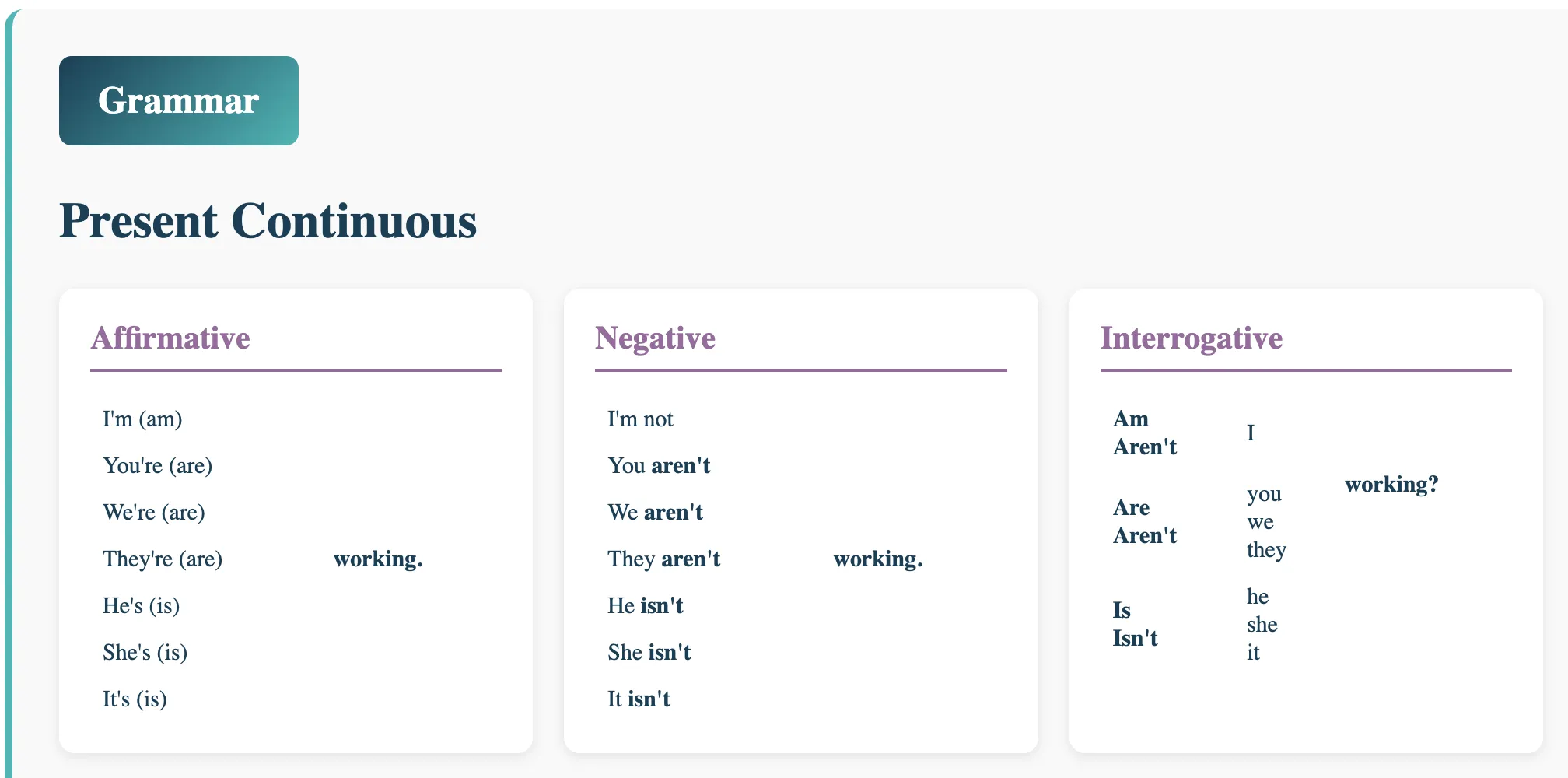
You use the Present Continuous form to talk about:
Activities happening at the moment of speaking.
- I’m phoning about the advert in the paper.
- Don’t interrupt me, please. I’m trying to concentrate.
- He’s wearing a grey suit, a white shirt and a blue tie.
- What are you doing?’ ‘I’m preparing this month’s sales figures.’
Activities or situations you see as temporary.
- He‘s working from home this week.
- We’re using this office until the new one is ready.
- I’m working from home today, so don’t phone me at the office.
Situations which are changing.
- The company is growing quickly.
- The economic situation is getting better.
- My English is improving.
You often use the Present Continuous with time expressions – at the moment, this week/month/year, etc.
- We are having a lot of problems with our suppliers at the moment.
- I’m doing a course this month, but it’s not very interesting.
Spelling of -ing form
Most verbs add -ing
Verbs ending in -e → remove the -e + add -ing
- come → coming
- take → taking
- write → writing
- make → making
Verbs with one vowel and one consonant → double the consonant + add -ing
- sit → sitting
- get → getting
- run → running
- fit → fitting
Present Continuous vs Present Simple
When he goes to Zurich, he stays in the Hotel Bahnhof.
(habitual situation)
He‘s staying at the airport hotel.
(now – on this trip)
She works for a marketing agency in Frankfurt.
(always true)
She‘s working in the Paris office this week.
(temporary situation)