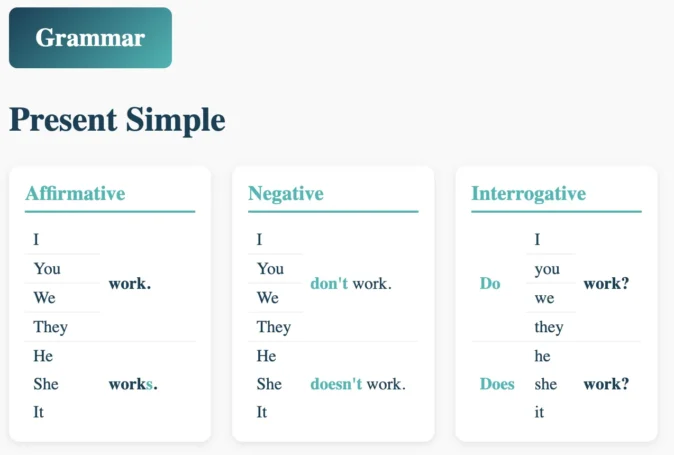
Use and Examples
You use the Present Simple to talk about routine actions and habits.
- I go to work by bus.
- He works late on Tuesdays.
You also use it to talk about stable ongoing situations.
- She lives in London.
- They employ over 250 people.
Practice Tasks
Task 1 (Write the correct word: am/ is/ are/ do/ does)
Task 3: Listen to the conversation
Two friends meet and talk about someone’s new job. Listen to their conversation and answer the questions.
a) What is the relationship between Eddie (the man) and Fiona (the person with the new job)?
b) How does Eddie feel about the new job?
Task 4
Audio script
Jennie: Hi, Eddie. How are you?
Eddie: Oh, hello, Jennie. I’m fine. And you?
Jennie: Fine thanks. How’s Fiona?
Eddie: Oh, she’s okay. She’s got a new job.
Jennie: Really? That’s good.
Eddie: Well, yes, I suppose so, but I’m worried she’s working too hard.
Jennie: Oh, dear. Does it involve long hours?
Eddie: Officially 40 hours, but she often works late. We don’t see her at home much.
Jennie: What’s she doing?
Eddie: It’s the same company – you know, educational software – but she’s regional marketing manager for Latin America now.
Jennie: Sounds impressive. What does it involve?
Eddie: Quite a lot! Apart from being in charge of the sales reps she also works on new product development and the whole marketing strategy of the company.
Jennie: Does it mean a lot of travelling?
Eddie: It seems to. At least a couple of trips a month.
Jennie: I see.
Eddie: I don’t mind that. It’s the weekends that cause problems.
Jennie: Does she have to work weekends?
Eddie: Not every weekend, but we can never make plans.
Jennie: Oh, dear. How much holiday does she get?
Eddie: It’s not bad. Three weeks a year. But that’s a long way off.
Jennie: You’re being a bit negative. Does she enjoy it?
Eddie: It’s hard work, but I think she enjoys the challenge.
Jennie: But you’re not very happy.
Eddie: I’m happy for her. The money’s good and it’s great for her career, but there is a downside.
Jennie: Well, it’s always difficult at the beginning. Anyway, give her my regards. Why don’t we go for a drink sometime?
Eddie: Okay, I will and yes, I’d like that.
(Press “NEXT” to continue the writing task)